Showing posts with label Leadholder. Show all posts

Thursday, November 04, 2010

Marie’s Leadholder

Following on from Monteverde Grafica, here’s my other 5.6mm leadholder. I really don’t know why I bought it, but I picked it up for a couple of bucks in a Dollar Store.
maries 5.6mm leadholder


maries 5.6mm leadholder
The tip and jaws are metal, the body is plastic with an almost rubberised sort of feel to it. Round grip section and octagonal main body.
leadholder front section

There is a rotatable lead hardness indicator, with selections 2B, 4B, 6B and 8B.
lead hardness indicator ring

I note that the packaging also implies HB lead is available, even though there's no such option on the hardness indicator.
leadholder packaging

There is no lead sharpener under the top cap, which isn’t intended to come off.

The brand is Marie’s, and according to the packaging that would be Shanghai SIIC Marie Painting Materials Co. Ltd.
brand and leadholder model number

For the price, this actually seems a pretty good buy to me.

Tuesday, November 02, 2010

Monteverde Grafica 5.6mm Leadholder

Monteverde Grafica 5.6mm Leadholder

After Vikrams leadholder articles, I thought I’d better just join in and show I’m not completely leadholder or clutch pencil-less. True, I don’t have many, but here’s the latest one I acquired. It tends to stand out from the crowd.

monteverde grafica leadholder
The Monteverde Grafica 5.6mm Pencil / Leadholder in the stained glass colourway. Other colour options, and ink options, are also available…well that should really be past tense as the Grafica is a ‘retried collection’ and no longer manufactured. Just FYI, Monteverde is a brand of Yafa Inc. of the USA.

Monteverde logo from the packaging
monteverde logo

Monteverde mountain logo on top cap

monteverde logo
"Monteverde USA" markings
The stained glass effect is embedded without borders, unlike stained glass lead light windows.
monteverde grafica stained glass leadholder

You do have some colour options in 5.6mm leads.
monteverde grafica coloured lead

The pocket clip has a rollerball on its end. It works well, pretty FAB.
monteverde rollerball pocket clip

Multi-toothed jaws. Push the top cap to open the jaws. There is a sharpener under the top cap.
leadholder jaws

I can imagine 5.6mm leadholders being suitable for some sketch artists and making rough layout drawings, etc.
moteverde grafica leadholder cartoon

At the end of the day though, for me personally...5.6mm... the answer is yes.monteverde grafica 5.6mm leadholder

Thursday, October 21, 2010

Fürst 5.6mm Leadholder

OK folks, here’s the second of Vikram’s guest articles.

Fürst 5.6mm Leadholder

The first thing I thought when I saw this leadholder for sale was, “That’s a huge lead!” and at 5.6mm, I have never seen one like it before. I bought it in the Deutsches Historisches Museum in Germany, and like it very much.
furst 5.6mm lead versus 0.5mm lead
5.6mm lead versus 0.5mm

furst 5.6mm leadholder and pentel mp
The Fürst 5.6 is just what it says it is, a leadholder with 5.6mm lead. It has an all metal body which is pretty heavy but very suited to sketching, the only thing I would do with this leadholder. The octagonal body is good because it doesn’t roll off the table, but it also does not force any particular hand position. It kind of reminds me of those large diameter children’s’ pencils, like “My First Ticonderoga.”
furst 5.6mm leadholder
Furst 5.6mm Leadholder
Disassembly reveals an all-metal inner mechanism - quality at its finest! Country of origin is not stated, but I am assuming it is Germany.
furst 5.6mm leadholder clutch pencil disassembled

The supplied lead is fantastic - a very soft lead (2B according to the manufacturer’s website) that does not smear very easily. Up top, the pushbutton twists off to reveal a sharpener - convenient!

Overall, I would highly recommend this leadholder to anyone who sketches or draws - it is a great tool to have!

Pros: All metal body, solid feel, great soft lead, octagonal body, built in sharpener

Cons: None

Price: about USD $11.60, € 8,90

Thanks again Vikram. Hope you are happy with your week.
Dave.

Tuesday, October 19, 2010

Faber-Castell TK4600 Leadholder Review

A while ago Vikram from Illinois got in contact with me and I persuaded him to do an article or a review for this blog. Well, the end result is that he sent in two articles, both on leadholders, because he quite rightly thought they were under-represented on this blog. So, this week is Virkam’s Leadholder Week, with two postings to publish. Here’s the first one.

Faber-Castell TK4600 Leadholder

Firstly, I would like to thank Dave for this great opportunity! I have been interested in pencils for a while, and at 16, I think I am the only one of all my friends to love pencils so much.

Faber-Castell: a name highly regarded in the pencil and writing instruments industry for high quality yet affordable products. As a drafting student, I was eager to try out one of their leadholders, the TK4600.
faber-castell tk 4600 leadholder clutch pencil
Faber-Castell TK 4600
This 2mm leadholder is a normal, economy grade pencil. The balance point is almost exactly at the midpoint, making this an ideal drafting instrument. A forest green, hexagonal body, similar to that of their Castell 9000 series of drawing pencils, makes it clear that Faber-Castell associates this leadholder to that high standard. The all plastic body of the TK4600 is very solid, similar to the Pentel P205 - able to withstand abuse and still deliver - a student model, for sure. The foil stamping on the body clearly states “TK4600 Faber-Castell” with “Germany” stamped in small letters on the clip. The metal tip section, (removable?) clip, and pushbutton show that Faber-Castell did not skimp on quality with this one.
faber-castell tk 4600 leadholder and wooden pencils

The grip of the TK4600 is aided by the ridges toward the front of the pencil, but they do not really help; when drafting, the draftsman generally holds the pencil farther away from the tip-closer to the midpoint. Maybe this was conceived as a multi-use pencil; one for occasional writing and sketching as well as drafting? While writing with the TK4600, it was very clear that it is not a writing tool primarily - after a half page, my hand started to develop a painful cramp. Sketching and drafting is comfortable, and this is plainly the TK4600’s forte. Another, slightly shorter version, the TK9500, has “HB” stamped into the body, making it seem like more of a sketching and writing tool than the TK4600.
faber-castell tk 4600 and tk 9500 leadholder clutch pencils
Faber-Castell TK 4600 and TK 9500
The TK4600 is a student leadholder, and a good one at that. However, the lack of a built in sharpener, higher price point (about USD $16, $12 for the TK9500) and the small grip section push me toward the Staedtler Mars 780 technico leadholder (USD $3-5) as a general leadholder. However, this one remains highly recommended!

Pros: -solid design and feel, great for drafting and sketching, solid metal clip

Cons: -high price for student leadholder, ridged grip in inconvenient place, no built-in sharpener

Overall: highly recommended, but consider Staedtler as well.

Thanks Vikram. Posting No. 2 coming in a few days.
Dave.

Tuesday, July 28, 2009

Modified Pentel Graph600

I know a few of you out there are quite keen on customizing and modifying your mechanical pencils. Here’s a little inspiration for you, just in case you haven’t already seen it. Over in Japan, Isu of the The Uncomfortable Chair blog likes a bit of modifying too. He recently sent me one of his modified pencils, the Pentel Graph 600 2.0mm. It started out in life as a Pentel Graph 600 0.5mm, but surgeon Isu transplanted some innards from (I think) a Stilus Secolgraf 151 Totmina 2mm leadholder to make the Graph 600 2.0mm. Pente' Graph 600 mechanical pencil modified to 2mm leadholderThose big clutch jaws look kind of freaky. Pentel Graph 600 leadholder clutch jawsclutch jaws openFor full instructions see the four instalments on Isu’s blog.

Sunday, February 11, 2007

Cleo Skribent Der Gessner Pencil Review

Cleo Skribent Der Gessner Pencil Review

1565 is a big year for pencil people, for it was then that “De Rerum Fossilium Lapidum et Gemmarum Maxime, Figuris et Similitudinibus Liber” by Swiss naturalist Conrad Gessner was published. In this great tome on fossils he included a sketch and brief description of a very useful new piece of equipment he had acquired, namely his pencil, and this is the very first record of a “modern pencil”, one that used graphite.

Conrad Gessner’s sketch and description of his pencil are reasonably brief and vague, leaving some room for conjecture over the exact details. He describes the pencil thus “The stylus shown below is made for writing, from a sort of lead, which I have heard some call English antimony, shaved to a point and inserted in a wooden handle.” So, some four and half centuries later, Cleo Skribent have taken this, and used it to produce “Der Gessner”, their version of Conrad’s pencil. So what exactly is Der Gessner? Well it’s quite simple really – it’s a turned, round wooden body (or holder) with a hole drilled up its length, but not so far as to come out the top. A standard 5.6mm lead fits up inside the body and is secured in place by a tapering wooden split sleeve at the mouth of the body. That’s it. So really, to my way of thinking, it’s actually a leadholder, a sketch pencil in my personal terminology, an ancestor of todays leadholders or clutch pencils.

Personally I don’t think Cleo Skribent are particularly well known as a pencil manufacturer, so by way of brief introduction, they are a German writing instrument manufacturer and for Der Gessner they emphasise their efforts to ensure the pencil is handmade to the highest standards in the tradition of the master artisan, and the German tradition of quality manufacture. They offer several different options for Der Gessner – for example in a hessian pouch, in a leather pouch, or a complete pencil set including knife, leads, etc all in a very interesting looking wooden box.

I’m pleased to say that I think Cleo Skribent have lived up to their own hype regarding quality of manufacture. The leather pouch is very fine leather, double faced where visible and well stitched. A plain simple piece of good quality work. My only quibble about the pouch is that it is a very light coloured leather and so can show graphite marks from when you take the pencil in and out of the pouch. These graphite marks are not that easy to remove. The pencil itself is equally good quality woodwork. Regular readers of this blog will know of my family connection to the “wood trades”, and my disappointment with a previous piece of wood I purchased. This time round, I am happy to say that I think the Der Gessner pencil is an excellent example of the woodturners art. Very smoothly finished and polished. Personally I prefer a slightly heavier grained wood, but that’s just a personal thing. I am glad they decided to stay with the natural finish and feel of the wood and didn’t apply a heavy clear lacquer or varnish finish to the pencil.

How does Der Gessner feel in the hand? For a such a large pencil its surprisingly lightweight. It’s quite a thick bodied pencil, actually a little too thick for me personally. To be honest, I have a touch of OOS/RSI/Carpal Tunnel and it was playing up, so that could be clouding my judgement. Anyway, like I say, I think I would have preferred a slightly thinner body. There is no special grip section or enhancements, but you don’t really need any with this pencil. It’s interesting to have the feel of wood beneath your fingers. I did find the flared lip at the base quite useful for positioning my fingers.

The body is perfectly round and there is no pocket clip so it will roll around on your desk when you put it down, which can get a bit annoying. Now I’m normally not that impressed with the erasers on most mechanical pencils, and Der Gessner has no eraser at all. I did wonder though if they hadn’t missed an opportunity to put one somewhere. Perhaps make the top knob a pull off one with an eraser underneath. But then I suppose that would be not be staying true to the original design.


As mentioned earlier, the lead is held in place by a split sleeve which itself push fits into the body. The sleeve can come loose during transport or if you drop the pencil, etc thus allowing the lead to fall out. Obviously the harder you jam the sleeve into the body the less likely this is to happen, but I worry about starting to deform the sleeve by pushing it in too hard. Good and tight in the short term, but in the long term it might affect the performance. I wonder if you can buy replacement sleeves? It appears the wood of the sleeve is a different species to the body, so presumably its been selected for its mechanical properties, and my fears are probably overstated. Sometimes you get a little creaking sound from the sleeve/body joint when you are writing, particularly as you rotate the pencil in your hand. This can also make the lead wobble just a fraction when you start writing again. Very occasionally the sleeve can be pushed in too lightly and the lead slides through the sleeve when you start to write, but this isn’t common and more a matter of getting used to how to use the pencil. But overall this sleeve system works quite well.
Photo - Der Gessner 5.6mm lead + sleeve, and 0.5mm lead for comparison.
Whoa! 5.6mm lead! Remember, way down deep, I’m a guy who still sort of thinks of 0.7mm as thick lead. So 5.6mm?!? Well, I didn’t bother trying to do any really fine writing on small font computer print outs, etc. I confined myself to more general writing. If you keep rotating the pencil then you can keep a reasonably sharp point on the lead for a period of time. The plain round body of Der Gessner assists with this. I tried sharpening the lead with a knife, but then thought I’d try an ordinary pencil sharpener. This initially took a little bit of effort, but once you’ve got the hang of it, it’s quite successful. It also puts a reasonably long tapering point on the lead. The leads supplied by Cleo Skribent are actually repackaged Koh-I-Noor leads. The 2B leads that came with my pencil are inscribed “KOH-I-NOOR HARDTMUTH 4865/2B”. Cleo Skribent appear to offer grades 2B, 4B and 6B, in plastic cases or glass tubes. The glass tube is basically just an ordinary test tube with a cork stopper, but I like the idea. It seems the sort of thing Conrad Gessner himself might have used. There are no markings of any kind whatsoever on the pencil or leather pouch. I generally prefer to have at least some indication of the manufacturer and model so you know what’s what in the future. I guess somehow they could impress a Cleo Skribent / Gessner logo somewhere.

Well, that’s about it from me. I salute Cleo Skribent for creating this pencil. I’m glad to own it, and I think that if you are a pencil collector then you have to consider getting a Der Gessner, because basically this is where it all started.
  • Best Points & Not So Good Points – As this is a piece of history, it doesn’t seem right to list “Best Points” and “Not So Good Points” from a modern perspective. I think a fellow Der Gessner owner summed it up best when he said his pencil was “…lovable, impractical and a good writer. And it draws attention at meetings.” [H.N.]
  • Price Range – Mid to High depending on the option you choose.
Dimensions – Length 154mm, diameter 12mm at main body. Balance point about 75mm up from the tip.

Photo - Der Gessner and some modern off-spring


Photo - Der Gessner and one of my uncles creations from an NZ native timber.


Part Two

Conrad Gessner (1516-1565) is an important figure in scientific history, particularly the natural sciences, and is sometimes referred to as “the founder” or “the father” of modern zoology. He was a great field naturalist and loved hiking in the mountains, both for study and for enjoyment. Now, I don’t want you to think that I’m trying to compare myself to Conrad Gessner, but if you have read this blog for a while you will probably be aware that I am a little bit of a part time-time field naturalist myself, and so as part of the review of this pencil I thought I should take “Der Gessner” out into the field, just as the great man himself would have done all those centuries ago. So, how does Der Gessner stack up against a modern pencil like the Lamy Scribble that I usually carry out in the field? Well, I guess we shouldn’t be surprised; time and technology has marched on since Conrad Gessner’s day, and there’s no real contest between Scribble and Der Gessner. To me, Scribble wins hands down. Der Gessner has no pocket clip although you could tie a string to the knob on top and attach it to a notebook. There is no eraser, it’s quite a large pencil so not really pocket-sized, its perfectly round and so rolls on a flat surface (the wind nearly rolled it off a bridge when I put it down for a second), the lead is not easily retractable, the lead can slip out of the pencil body during transport and so on. Now this all sounds negative, but lets be perfectly clear here, I have no doubt that it was an absolutely stunning improvement on what field naturalists would have had before these pencils became available! Imagine carrying quill and bottled ink around outdoors and trying to quickly write a few notes! Or wax tablets and scriber. Compared to these, a piece of graphite in a wooden holder would have been a fantastic improvement. Talk about convenience! The “best thing sliced-bread”, but then they didn’t have sliced bread back then. Perhaps people said “The best thing since the pencil” when sliced-bread first came onto the market? I’d like to finish this on a positive note – I thoroughly enjoyed using Der Gessner outdoors for a day, it was a great little emotional link to the past, giving me a real sense of history. Get yourself one soon.

Monday, February 05, 2007

Clutch Pencils

A while ago I put up a posting on sketch pencils, so it seems time to say something about their brothers, clutch pencils. Actually the term ‘leadholder’ is probably a more precise name for what I mean when I say clutch pencil. I am talking about those pencils that take a long stick of (usually) 2mm lead and it’s held in a little set of jaws at the tip.
Photo - Koh-I-Noor 'Technigraph 5611 C' (Italy), Rotring 300 (assume Germany), Staedtler 'Mars 780' (Germany)


My earliest definite memory of a pencil is actually of a clutch pencil. I think I was about 7, and I remember finding a dusty old clutch pencil tucked away in a forgotten corner of my father’s home-workshop. I recall it had a plastic body and a diamond cut chrome metal grip section that was starting to corrode. It was very aggressive on the skin! It was from some far-away foreign land like Germany. I don’t think I had ever seen any sort of non-wooden pencil before. You are probably thinking it’s rather strange I remember all this. A bit mad even by my standards! Just another confirmation of what a nutcase I must be. Well I think there is a reason I remember this, it’s because this particular memory continues on just a little bit longer to when I found something else, a Stanley knife, and then there was lots of blood! Man I was scared. Luckily though, I missed the really important bits of me, and the doctor stitched me up as good as new.

I have some sort of a like-dislike thing going on with clutch pencils. Perhaps it’s because of my early association of them with a scary incident? I want to like them more, but I just don’t. On the other hand, I’ve always been rather intrigued by the leads and their packaging.

These days clutch pencils are obviously completely out-sold by ‘ordinary’ thin-lead mechanical pencils. I’m no expert, but as far as I can figure it out, "thin-leads" started to become available in the late 1950’s, early 1960’s. I think they had improved in strength and become commonplace by the mid-1970’s. From a few old sales catalogues and adverts that I’ve looked at, in the late 1950’s and early 60’s you often see 0.9mm (0.036”) lead called Real Thin lead and 1.18mm (0.046”) called Standard lead. By the early 1970’s there are Ultra-Thin or Super-Thin 0.5mm (0.020”) leads, and by the 1980’s 0.5mm thin-lead mechanical pencils dominate the scene, so much so that they are often no longer referred to as Super-Thin leads, they’re just normal. Staedtlers website implies they released their Mars Micro thin leads in the 1970’s.

In the early 1980’s, I recall a tutor in my drawing class talking to us about what pencils to use. He suggested a couple of 0.5mm mechanicals, but also mentioned we could of course use traditional clutch pencils and sharpen the lead with sandpaper, or a little lead-pointer, but why bother? Then a little later when I was out in the workforce I remember that most of the older guys had a clutch pencil in the pencil holder on their desks, but they used thin-lead mechanical pencils. Their clutch pencil was sort of like “Old Favourite” they just couldn’t throw away, but didn’t actually use anymore.

I don’t really have a lot of clutch pencils, but somehow I am slowly ending up with a collection of leads. You can buy these leads for a few dollars on eBay, but then I live in a land far far away, so shipping often costs many times the price of the item. Not quite such a bargain. Anyway, here are a few pictures. Perhaps more to come in the future.
Photo - a box of Stabilo leadsPhoto - Two generations of Staedtler
Photo - VERITABLE PROOF THAT LIFE ISN'T FAIR! - Two tubes of Staedtler leads, note how the printing runs from the end to the white/black cap on the top one, but is reversed on the other one, running from the cap to the end. If I was a stamp or coin collector this sort of reverse printing would surely make me a rich man!

Footnote: Now if you really want to know about these types of clutch pencils or leadholders, then Leadholder.com is the place for you. Its chock full of all sorts of interesting stuff, but be warned, there might be a few snippets of slightly PGR rated stuff, like a bad word or a picture of “Hot Hot Heidi” the Staedtler girl.

Thursday, September 28, 2006

Sketch Pencils

Sketch pencil is the name often given to those mechanical pencils that use very thick leads - by that I mean leads like 3.2mm and 5.6mm. Personally I don’t normally include 2mm clutch pencils in the ‘sketch pencil’ category because they were usually used for draughting and other purposes, whereas the thicker leads are really specifically for artists to draw with. At least that’s my view of things.

Actually perhaps “leadholder” is a more appropriate term than “mechanical pencil” as most, if not all sketch pencils are clutch mechanism pencils.

I’m no artist and I don’t really have many sketch pencils, but here are a few photos of two that I do have.

The Koh-I-Noor ‘Versatil’ 5347, 5.6mm clutch pencil


You can see how thick the 5.6mm leads are, pictured here with an ordinary wooden pencil. They are huge!

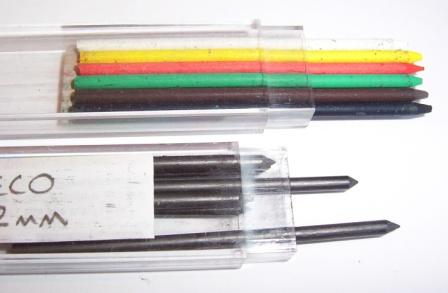
Some 3.2mm Kaweco leads – graphite and coloured. There doesn’t really seem to be a lot of coloured leads available, certainly not compared to ordinary wooden coloured pencils.

5.6mm and 3.2mm pencils.

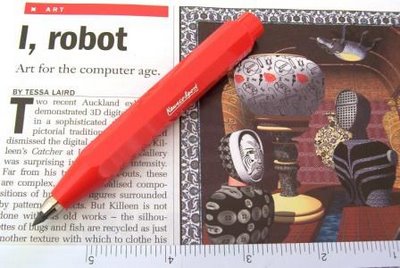
The Kaweco “Sport” bunt 3.2mm clutch pencil is short and wide, of octagonal cross-section. It is 104mm long x 13mm wide across the flats, that’s about 4 x 1/2 inches.

Now, for the artist who likes a pencil with a stratospheric price tag, there is the Montblanc Leonardo Sketch Pen (it’s a pencil), as reviewed over at Paper and Pencil.

“Ladybug” and “Butterfly” in graphite and coloured pencil, by one of my young relatives. The Leonardo is definitely beyond her price range, but if she grows up to be a famous artist…