The recent Cult Pens Mechanical Pencil Day Giveaway was won by 'Dash Lambda'. Here is his review of the pencil that he chose as his prize.
Hello! I’m not great at introductions, so here’s the gist: I’m the guy that won the Cult Pens giveaway, and here’s a review of what I got, thanks to Cult Pens:
It’s a LAMY 2000 pencil, .5mm flavor. It comes in a rather serious-looking box, probably the fanciest packaging I’ve ever dug a pencil out of. The 800 just came in a triangular tube, and the Nero’s box was big and stylized but still just a normal cardboard box. Ultimately packaging is just packaging, but they certainly did put some effort into it.
Picking the pencil up, the first thing I noticed was the weight. I like heavy pencils, and while this is probably relatively heavy, that’s not really what we feel: We feel density. Like that demonstration a lot of you probably had in some science class where you hold a 1” ball bearing and a ball probably twice the diameter of a baseball and try to say which one is heavier; it’s a trick question, they weigh the same. This thing is not the ball bearing. But, after using it a while, I find it’s dense enough.
The second thing I noticed was the rattle. Exactly the same as the Nero’s rattle, the lead reservoir is held at the clutch end and there’s enough of a gap at the eraser end for the button to move slightly. Also like the Nero, this can be eliminated by wrapping packing tape around the metal tube on the button cap.
The clutch end is held quite securely, so no problems there. The tip is not retractable, but it’s short and conical so it doesn’t really pose a problem.
I feel that pictures are a bit deceptive about this thing’s size (not that the perspective in the one above does anything to help the matter). It’s actually shorter than an extended 800, about the same length as the Nero. It’s fatter than them all, though really not as fat as it looks.
Before getting on to build quality, this has to happen to everything I own:
Everything.
Notice how the body separates about ¾” up from the steel end, rather than at the steel end. This may seem like an odd choice, but in my experience plastic-on-plastic threading lasts considerably longer than metal-on-plastic. Maybe I’m wrong, but to me this says an engineer somewhere at LAMY decided to sacrifice cost for longevity, and I applaud that.
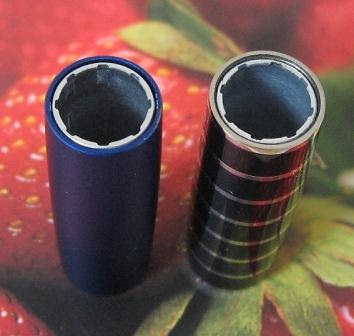
Speaking of cost vs longevity, look at that lead reservoir. And that clutch housing. As far as I can tell, the only plastic parts on this pencil are the body and button knob. That ring on the clutch housing is rubber, it appears to be a cushion for the mechanism. This pencil is very well engineered and manufactured, it doesn’t creak or bend and it all fits together perfectly. A testament to the build quality is the fact that if you weren’t familiar with the L2K family, you probably thought it separated at the metal, because the seam is almost invisible… Except for here, at least. In my pictures it’s more visible than it is in person. Odd.
As for the mechanism, I like it. There’s a lot of travel with a rather definite knock point, not as clicky as a P205, but not as mushy as an 800. It spits out 8mm of lead for ten clicks, I found two clicks to get you what you need to write. Not as precise as a lot of drafting pencils, but this isn’t a drafting pencil.
The clip is awesome. This thing isn’t gonna bend like a Rotring’s, it easily slides over thick pockets, and it holds on securely. It has a very slight side-to-side play, but that’s hardly even noticeable.
I’m not sure why you would want to, but you can indeed take the clip off just fine.
If you’ll be taking the clip off and putting it back on regularly, you’ll notice a ring start to develop on the body where the clip touches it. It would do that even if it were metal.
You can see a brass flap in the mounting point for the clip; that’s the wear point where the clip’s spring lands. That flap is actually part of a brass tube lining the whole end piece, accompanied by a brass ring on the mating end of the body:
That one took me a bit to figure out, but it’s another structural wear point. The lip on the clip pushes against the inside of that brass ring, and that can amount to a lot of force. LAMY went through this thing carefully addressing every wear point they could find.
As for balance…
Rotrings, at least 600/800s, are balanced perfectly on the “O” in “rOtring,” and taking the clip off shifts the balance point to the “r.” There’s no signage on the L2K’s body to point to, but it’s normally slightly bottom heavy and removing the clip shifts the balance point about ¼” further downward. So it’s a heavy clip.
I appreciate evenly balanced pencils, but after getting the Nero I found an equal appreciation for bottom-heaviness. The balance, the material, the size, the weight, the shape, everything about this pencil is just comfortable. I’ve never found Rotrings uncomfortable, but they still feel like heavy chunks of brass whose existence doesn’t depend on this meager reality. The L2K feels like a finely crafted instrument that recognizes you’re a human, with squishy human hands.
So what’s bad about it? Well, a couple things.
First of all, the conical tip isn’t as blunt as one might expect for a non-retractable pencil. You’re certainly not going to bend it or poke holes in things, but it’s a tiny bit sharp in that edge-of-a-soda-can way, and likes to grab onto fabric if you’re trying to push it into a crumpled pocket or something. The Nero had that problem too (the sleeve pokes out just a tiny bit when retracted), but because the mechanism of that pencil relies on the sleeve touching the paper it smoothed out quickly.
The worst part, though, is the eraser. I’m one of those freaks that actually uses the integrated eraser, in fact I use it more often than my block eraser. With the Nero I was disappointed that the cap was so tight that putting it back on meant clicking out lead, but even then the eraser itself was fine. This thing? This thing is pathetic. The cap is just as tight as the Nero, it erases like a super-ball, the length of a new eraser is such that you’re in danger of breaking it when you use it, and the first time I took the cap off I didn’t even know it had an eraser because it stayed in the cap. Every time I take the cap off I have to push the eraser back down, it’s just not secure.
Anyway… One surprising thing was the lead it came with. Stock lead is really hit-or-miss. Rotrings come with Tikky lead (which is by most accounts the smoothest lead on the market), Pentels I think usually come with Hi-Poly, and everything else is a lottery. But one thing you can be certain of is that they all come with HB. Yeah. This thing comes with 3B. Maybe a soft 2B. I don’t normally like soft leads, but I also usually use drafting pencils; it actually feels right for this one. International shipping wasn’t kind to it, though; every single stick had about 1cm broken off the end. Either way, that’s another thing that someone actually thought about, they didn’t just throw in the same thing everyone else does.
I think this is a great pencil. I actually think I’ll start carrying this one in my pocket and my Rotring in my bag, because I’ve had to re-bend the Rotring’s clip a few times now and it’s already not touching the barrel again. This clip won’t do that; it just won’t. Small details like the full metal lead reservoir and mid-body separation say LAMY wasn’t pinching pennies when they built it, and that certainly shows. The eraser is a travesty, but I do also carry a Boxy anyway.
In the story I shared for the giveaway, I said I didn’t have much of a collection because I hated not using tools. The three I had before this have specific purposes: A Rotring 800 I know from experience I can take through hell and back, a Nero for when my handwriting gets microscopic (I’m a math major, it’s a problem), and a P205 for lending. Now I have the pencil that can live clipped to my pocket without regular clip-maintenance, and I enjoy using it.
I partly chose the L2K to test the waters before getting the fountain pen. When a company takes a well-loved pen or pencil and expands it into a series the results aren’t always up to the standard of the original; for example, the 800 ballpoint is nice, but a couple parts from the function-over-form pencil are left in as vestigial decorations to make it look like the pencil, a couple little details are just missing, and you can just tell it’s not the 800. The L2K does not give me that feeling. It feels like LAMY put honest and practical thought into making a good pencil. I’m still a little disappointed it doesn’t retain the cap, but at the same time that’s one of the differences between a fountain pen and a pencil: A pencil doesn’t need a cap. And unlike the Kaweco Sport, the cap isn’t an integral part of the design. Kaweco…
So to me this feels like a product from a company that understands not only how to make a good tool, but also what is and isn’t important when making a family of products. It’s a good sign for the rest of their lineup.
Thanks Dashy. That's a very detailed review. Also of course, thanks again to Cult Pens for the giveaway and their Mechanical Pencil Day.
My Lamy 2000 has been, and still is, my everyday pencil used in the office at work, and was one of the earlier mechanical pencils that I reviewed on this blog. Here's some links to older Lamy 2000 content on this blog. From many, many years ago...
My 2000 review
2000 and Scribble
Showing posts with label Lamy. Show all posts
Sunday, August 04, 2019
Friday, November 11, 2011
Packaging
I have been silent for a long time now. I would like to say that the rest has refreshed me, and that my muse has returned, but it hasn’t. However, I get occasional flashes of inspiration, like last weekend when I was moving the collection to its new home in a nice big storage cupboard. I was rearranging the Lamys, Rotrings and a few others and was struck by the variety of boxes they used. Perhaps they are not so important to many collectors, but I’m sure for many people who are buying a writing instrument above the everyday price range, then a nice presentation package or box is part of the decision making process, particularly if it is a gift. From some catalogues I have, it seems that most writing instrument sellers have a standard range of packages and boxes, and within reason retailers have some choices to do some mix and match of boxes, particularly within the business ranges offered to corporate gift buyers. So, here’s a quick selection of packages from my Lamy collection.
Lamy are a company who pride themselves on design and innovation, and some, though not all, of their packaging matches that.
A clear plastic cigar tube sort of container. I really quite like this one.
Very unusual. Black foam, split in two with a hole drilled down the middle for the pencil to fit into. This is the sort of thing that sets Lamy apart. I am surprised they do not do more of this unusual type of packaging, although it is not terribly functional.
A clear plastic package with silver-paper binder. Unusual, but I’m not so sure I like it that much. Let’s say it is a little bit too economy class when matched with a Lamy.
These cardboard packages are a staple of the Lamy range. The grill-like cut-outs are some attempt to set them apart from others.
These plain metal containers are another common offering from Lamy, and lots of others too.
Plastic cases are another common alternative to the metal cases. Nice enough, but nothing special.
A more expensive and less common plastic case, double hinged.
A somewhat more retro case on an older pen-pencil set.
Another older item, with a cardboard case with elastic binder.
This may not be the greatest post to make a return with, and the photography may not be the best, but hey, I had some inspiration, 10 minutes spare time and Arnie’s comment gave me a kick in the pants at just the right moment. So there you have it.
Lamy are a company who pride themselves on design and innovation, and some, though not all, of their packaging matches that.
A clear plastic cigar tube sort of container. I really quite like this one.
Very unusual. Black foam, split in two with a hole drilled down the middle for the pencil to fit into. This is the sort of thing that sets Lamy apart. I am surprised they do not do more of this unusual type of packaging, although it is not terribly functional.
A clear plastic package with silver-paper binder. Unusual, but I’m not so sure I like it that much. Let’s say it is a little bit too economy class when matched with a Lamy.
These cardboard packages are a staple of the Lamy range. The grill-like cut-outs are some attempt to set them apart from others.
These plain metal containers are another common offering from Lamy, and lots of others too.
Plastic cases are another common alternative to the metal cases. Nice enough, but nothing special.
A more expensive and less common plastic case, double hinged.
A somewhat more retro case on an older pen-pencil set.
Another older item, with a cardboard case with elastic binder.
This may not be the greatest post to make a return with, and the photography may not be the best, but hey, I had some inspiration, 10 minutes spare time and Arnie’s comment gave me a kick in the pants at just the right moment. So there you have it.
Labels:
Lamy
Tuesday, November 30, 2010
Lamy Logo Mechanical Pencil Review
Lamy Logo 105 Mechanical Pencil Review
It’s been quite a long time since a Lamy mechanical pencil featured on this blog, so it’s time to put things right. Here then we have the Lamy Logo model 105 black mechanical pencil.The Logo is part of what Lamy call their Modern Office range, as opposed to their High Quality Writing or Young Writing ranges. Modern Office…well the Logo does have a relatively modern looking style about it. Stainless steel and black plastic body, square end to the body and pocket clip mount. Overall then it’s a fairly plain simple look, but with a stylish silhouette.
Like most Lamy writing instruments the Logo comes in other system options – BP, FP and multi-pen. The 105 option has a stainless steel body with a slightly brushed finish, but is mirror polished on the clip. The plastic accents are black on mine, but there are other colour options. There is also the Model 106 which is brushed stainless steel, and the Model 104 which is a black resin body.
Weighing in at about 13 grams, the 105 is definitely not in the heavyweight class, despite its steel body and reasonably substantial dimensions. The grip zone is formed by a series of rounded rings pressed into the steel which feel quite nice under-finger and work very well at keeping your grip firm. There are also some ridges on the upper part of the plastic tip for those who like to grip their pencil really close to the tip. They also of course continue the ridged aesthetic look.
The Logo mechanical pencil is only available in 0.5mm lead size. The lead sleeve is a 2mm long thin pipe, not long enough for drafting work. It is retractable for pocket safety. Now this is the bit that a small number of you are not going to want to hear. Wobble. Yes, lead wobble. It’s not bad and didn’t really worry me, but there is definitely some wobble between the small black plastic front cone and the black plastic front section. Then there is also some wobble between the lead sleeve and the black plastic front cone that it is inserted into. Some of this is possibly due to lead cushioning, and for general writing it’s of little to no concern, but it’s there and some of you ask about lead wobble. There is a lot of cushioning in the tip, you can feel the lead springing back if you press hard onto the paper. It’s also a fairly noisy pencil. There is rattle of the internals, and the spring motion of the lead cushioning also sometimes produces some springy sounds. I didn’t actually mind the aural experience, but some might.
As you would expect, it is a standard push top ratchet mechanism pencil. Ten clicks will get you about 9mm of lead. The pencil though has two somewhat unusual features for a push top ratchet pencil. Firstly, there is no eraser under the push top button, or anywhere else for that matter. Secondly, you don’t refill the lead magazine by removing the push top button. Instead, you unscrew the plastic front section from the body, pull the innards out, and then you can pull the little cap off the refill magazine and stick a couple of pieces of lead in. Note the lead jam clearing needle on the refill magazine cap. As is so often the case with my Lamy’s, no instructions were included in the box. With a bit of effort you can find instructions on the Lamy website, but it would be better if they were included with your purchase.
The pocket clip is spring loaded and very functional. It slides onto anything with ease, yet has the strength to keep the pencil clipped on.
As is usual for Lamy, their logo and branding is minimal and muted. “Lamy” printed at the top of the body by the pocket clip is the only marking on the pencil. There is no indication of country (incorrect - see reader comments), model name or lead size.
A nice pencil, as always, from Lamy.
• Best Points – Good looks, good pocket clip.
• Not So Good Points – No eraser, noise?
• Price Range – Low/Mid.
• Does this pencil make it into the Top 5? - No.
Dimensions – Length 137mm, diameter 10mm. Balance point about 80mm up from the tip.
This Lamy Logo 105 mechanical pencil was provided to me by Cult Pens. Thanks Cult Pens.
Labels:
Lamy
Sunday, November 22, 2009
2000 and Scribble
I don’t usually write direct comparisons of mechanical pencils in the “Mechanical Pencil A v Mechanical Pencil B” style, but quite a few people ask those sort of questions, so I have decided to do this comparison of two mechanical pencils that are always close at hand when I have something to write.
Lamy 2000 compared to Lamy Sribble. Note that I am comparing 2000 to the Scribble 0.7mm mechanical pencil which has several differences to the Scribble 3.15mm clutch pencil.
The 2000 is a long tapering classic minimalist style mechanical pencil. Scribble is somewhat more unusually shaped. This photo hopefully demonstrates the difference in length and width between the two.
Weighing in at 19g, 2000 is 138mm long by 12mm diameter whilst Scribble weighs in at 25g and is 120mm long by 14mm diameter. Not surprisingly this difference in weight and dimension produces a substantially different feel in the hand.
2000 looks and feels long, slender, lightweight and precise versus the short, solid, robust, chunky heavyweight Scribble.
2000 has a brushed surface finish which gives a very pleasing tactile experience in the hand. This finish provides good grip and over the long term some patina from use may build up. Scribble has a lightly sandblasted type finish which also gives reasonable grip but doesn’t feel as interesting to the fingers.
2000 has a fixed conical sleeve. It is still a reasonably fine diameter at the point and I would describe it as only semi-pocket safe. On the other hand Scribble has a short retractable metal pipe sleeve. When retracted Scribble is considerably more pocket safe than 2000.
The black coating on the push top button of my Scribble has worn and scratched over the years through wear against the main body.
Both have small erasers under the top cap, and neither are worth further mention. Both also have clean out rods under the eraser which is nice little extra.
Both have strong functional metal pocket clips.
Both these mechanical pencils are great things, but Lamy clearly intend these two mechanical pencils to occupy different niches - 2000 is a 'fine writing instrument' and all that implies. Scribble is no lesser a testament to Lamys design ethic, but it is a note-taker, a jotter, a sketcher.
Further reading from this blog:-
Lamy 2000 Mechanical Pencil Review
The Life of 2000
Lamy Scribble Mechanical Pencil Review
A Day In The Life Of Scribble
Lamy 2000 compared to Lamy Sribble. Note that I am comparing 2000 to the Scribble 0.7mm mechanical pencil which has several differences to the Scribble 3.15mm clutch pencil.
The 2000 is a long tapering classic minimalist style mechanical pencil. Scribble is somewhat more unusually shaped. This photo hopefully demonstrates the difference in length and width between the two.
Weighing in at 19g, 2000 is 138mm long by 12mm diameter whilst Scribble weighs in at 25g and is 120mm long by 14mm diameter. Not surprisingly this difference in weight and dimension produces a substantially different feel in the hand.
2000 looks and feels long, slender, lightweight and precise versus the short, solid, robust, chunky heavyweight Scribble.
2000 has a brushed surface finish which gives a very pleasing tactile experience in the hand. This finish provides good grip and over the long term some patina from use may build up. Scribble has a lightly sandblasted type finish which also gives reasonable grip but doesn’t feel as interesting to the fingers.
2000 has a fixed conical sleeve. It is still a reasonably fine diameter at the point and I would describe it as only semi-pocket safe. On the other hand Scribble has a short retractable metal pipe sleeve. When retracted Scribble is considerably more pocket safe than 2000.
Both are normal push top button ratchet advance mechanisms, but they produce an unusually long length of lead. Ten clicks on 2000 will get you a whopping great 11mm of 0.5mm lead. On the other hand ten clicks on Scribble will get you 9mm of 0.7mm lead - that’s actually still quite a bit, despite being a shorter advance than 2000. Some recent comments on this blog have noted lead breakage problems with 2000. I definitely agree that 2000 takes some getting used to, and until you do so, you may have lead breakage problems. I personally believe most of the problems are associated with the unusual length of lead advanced by the mechanism. When you first start writing, two clicks of 0.5mm lead is way too much and you will probably snap it. You also need to get used to allowing the lead to wear right down before advancing another length. Lead breakages will also be reduced if you adopt a fairly upright stance when writing, and use superior quality leads. If you are happy writing with either 0.5mm or 0.7mm lead, and want a 2000, then I’d definitely recommend you choose the 0.7mm for improved resistance to breakages.
The black coating on the push top button of my Scribble has worn and scratched over the years through wear against the main body.
Both have small erasers under the top cap, and neither are worth further mention. Both also have clean out rods under the eraser which is nice little extra.
Both have strong functional metal pocket clips.
Both these mechanical pencils are great things, but Lamy clearly intend these two mechanical pencils to occupy different niches - 2000 is a 'fine writing instrument' and all that implies. Scribble is no lesser a testament to Lamys design ethic, but it is a note-taker, a jotter, a sketcher.
Further reading from this blog:-
Lamy 2000 Mechanical Pencil Review
The Life of 2000
Lamy Scribble Mechanical Pencil Review
A Day In The Life Of Scribble
Labels:
Lamy
Thursday, November 12, 2009
Cross ATX Mechanical Pencil Review
The Cross ATX mechanical pencil appeals to my personal tastes. The body is a gently tapering shape and the pocket clip flows onto the body, continuing the smooth elegant lines. Classical simplicity. Mighty attractive.
My ATX mechanical pencil is the cyanic blue with chrome trims colour option. The cyanic blue is a very dark shiny blue lacquer type finish which shows many fine striations when the light hits it in a certain direction. Apparently this is actually reflections from the brushed metal finish of the main body beneath the lacquer. The ATX is a reasonably substantially sized writing instrument, but at 25 grams and with a fairly central balance point, it is somewhat lighter in the hand than its size and dark colouring might otherwise suggest.
Down in the general area where most would grip the pencil the diameter is about 8 – 10mm. The lacquer finish is smooth and shiny, but as far as such finishes go, and combined with the reasonable body diameter, it provides an acceptable level of grip.
The lead advance mechanism is twist top ratchet. The top half of the body is rotated to activate the lead advance one increment and then it springs back. If you have good dexterity then you can operate it one handed, but many would need to use both hands. There is quite a bit of rotation before the lead advance mechanism is engaged which means there is an amount of play between the two halves of the pencil and at times there is some intermittent wobble noise when writing with the pencil. Ten activations of the mechanism will advance about 6mm of the 0.5mm lead.
The lead sleeve is a short 2mm long pipe and it is a fully retractable sliding sleeve so the pencil as fully pocket safe as you would expect from a luxury writing pencil. If you twist the top half of the body the opposite direction than that which advances the lead, then the twist mechanism locks and the lead and sleeve can be pushed back into the body. This twist and lock feature of Cross mechanical pencils was pointed out to me by a commenter on this blog earlier this year. Just like push top ratchet mechanisms you can of course also push the lead and sleeve back into the body when the mechanism is at held twisted at its maximum lead advance position.
The top half of the body pulls off to reveal a small eraser, which in turn pulls out to allow access to the lead refill chamber. The mechanism housing is clearly marked “PAT. 5,662,424”.
My ATX pencil was purchased a few years old and it states on the protective packaging sleeve “Assembled in USA with US and foreign components”. I don’t know what country of origin statement is on the mechanical pencils currently shipping from the A.T. Cross company distribution centre.
• Best Points – The looks.
• Not So Good Points – That occasional rattle noise can be annoying.
• Price Range – Mid.
• Does this pencil make it into the Top 5? - No.
Dimensions – Length 141mm, diameter 12mm at widest point. Balance point about 75mm up from the tip.
But wait, there’s more! (Though no free steak knives)
Clips - sprung and not sprung.
The Cross ATX mechanical pencil appeals to my personal tastes. The body is a gently tapering shape and the pocket clip flows onto the body, continuing the smooth elegant lines. Classical simplicity. Mighty attractive.
My ATX mechanical pencil is the cyanic blue with chrome trims colour option. The cyanic blue is a very dark shiny blue lacquer type finish which shows many fine striations when the light hits it in a certain direction. Apparently this is actually reflections from the brushed metal finish of the main body beneath the lacquer. The ATX is a reasonably substantially sized writing instrument, but at 25 grams and with a fairly central balance point, it is somewhat lighter in the hand than its size and dark colouring might otherwise suggest.
Down in the general area where most would grip the pencil the diameter is about 8 – 10mm. The lacquer finish is smooth and shiny, but as far as such finishes go, and combined with the reasonable body diameter, it provides an acceptable level of grip.
The lead advance mechanism is twist top ratchet. The top half of the body is rotated to activate the lead advance one increment and then it springs back. If you have good dexterity then you can operate it one handed, but many would need to use both hands. There is quite a bit of rotation before the lead advance mechanism is engaged which means there is an amount of play between the two halves of the pencil and at times there is some intermittent wobble noise when writing with the pencil. Ten activations of the mechanism will advance about 6mm of the 0.5mm lead.
The lead sleeve is a short 2mm long pipe and it is a fully retractable sliding sleeve so the pencil as fully pocket safe as you would expect from a luxury writing pencil. If you twist the top half of the body the opposite direction than that which advances the lead, then the twist mechanism locks and the lead and sleeve can be pushed back into the body. This twist and lock feature of Cross mechanical pencils was pointed out to me by a commenter on this blog earlier this year. Just like push top ratchet mechanisms you can of course also push the lead and sleeve back into the body when the mechanism is at held twisted at its maximum lead advance position.
The top half of the body pulls off to reveal a small eraser, which in turn pulls out to allow access to the lead refill chamber. The mechanism housing is clearly marked “PAT. 5,662,424”.
Now, if you look that up on Google Patents, you will see that it is for a “ ‘Mechanical Pencil’ Assignee A. T. Cross Company, Lincoln, R.I. Inventors Kageyama Shuhei; Ebinuma Tadayoshi, both of Saitama-ken, Japan; Thomas Clem, Lincoln, R.I.” Now, those first two names and their address didn’t exactly fit with A. T. Cross and it piqued my interest. This patent lists two other patents in its citations section, so I thought I’d follow through to them. The first of these is “ ‘Rotary knock type mechanical pencil’ Inventors: Hidehei Kageyama, Robert V. Lozeau Assignees: Kotobuki & Co., Ltd., A. T. Cross Company” Ahhh, Kotobuki, now there’s an interesting relationship revealed. Anyway, I won’t rush off on that tangent any further…for the moment.
“CROSS” is marked clearly on the pocket clip. The pocket clip is strong and will certainly keep your pencil attached to whatever you clip it to. It’s very hard to see, but “CROSS” is also marked on the top half of the body, near the centre ring.
My ATX pencil was purchased a few years old and it states on the protective packaging sleeve “Assembled in USA with US and foreign components”. I don’t know what country of origin statement is on the mechanical pencils currently shipping from the A.T. Cross company distribution centre.
• Best Points – The looks.
• Not So Good Points – That occasional rattle noise can be annoying.
• Price Range – Mid.
• Does this pencil make it into the Top 5? - No.
Dimensions – Length 141mm, diameter 12mm at widest point. Balance point about 75mm up from the tip.
But wait, there’s more! (Though no free steak knives)
Back on 9 September, ‘Benjamin’ left a comment on this blog suggesting I review the Cross ATX mechanical pencil, and also compare it to the Lamy 2000. Now, I don’t normally do that sort of comparison thing, but without establishing a precedent…here are a couple of photos of the Cross ATX and Lamy 2000 so you can get more of a direct comparison between the two.
18 grams for 2000, 25g for ATX.Clips - sprung and not sprung.
Thursday, September 03, 2009
Let's Talk Mechanical Pencils with Lamy
Recently I’ve been wanting to know a little bit more about some of my favourite mechanical pencil companies, and the mechanical pencil market in general. I own more than my fair share of Lamy’s, so I thought I’d approach them and see if they would participate in a brief Q&A type interview about themselves and their pencils. Luckily they readily agreed to an “interview”, and below are a few questions I put to Andrea Schuch of Lamy’s International Sales Department in Heidelburg, Germany and her replies.
Dave - Well firstly I would like to thank you for taking the time to answer these questions. Perhaps to start with you could give me a brief introductory run down on Lamy.
Andrea - Lamy was established in 1930 in Heidelburg, Germany. We have approximately 370 employees, of which 2/3rds work in production, making approximately 7 million writing instruments annually. Our sales turnover is approx. €50 million/year, through 6,500 specialist dealers in Germany, and distribution partners in 62 other countries. Currently our range comprises 27 different series of writing instruments.
Every Lamy product embodies our brand values: Design – Innovation – Quality. Lamy not only develops modern, sophisticated designs, but also conducts ongoing research into technical innovations which raise the functionality of writing instruments. Lamy is 100 per cent “Made in Germany” and we have more than 100 international design awards.
Lamy head office & factory
Factory and roof garden sculpture
Some of the team at Lamy. The gentlemen in centre-front with the light suit and the sun glasses is Dr. Manfred Lamy, owner of the company and to the right in the dark suit with tie is Mr. Bernhard Roesner the CEO of Lamy.
Dave - Well firstly I would like to thank you for taking the time to answer these questions. Perhaps to start with you could give me a brief introductory run down on Lamy.
Andrea - Lamy was established in 1930 in Heidelburg, Germany. We have approximately 370 employees, of which 2/3rds work in production, making approximately 7 million writing instruments annually. Our sales turnover is approx. €50 million/year, through 6,500 specialist dealers in Germany, and distribution partners in 62 other countries. Currently our range comprises 27 different series of writing instruments.
Every Lamy product embodies our brand values: Design – Innovation – Quality. Lamy not only develops modern, sophisticated designs, but also conducts ongoing research into technical innovations which raise the functionality of writing instruments. Lamy is 100 per cent “Made in Germany” and we have more than 100 international design awards.
Lamy head office & factory
Factory and roof garden sculpture
Dave - A lot of high-end brands don’t offer many mechanical pencils, but Lamy is a little different, offering a pencil option with most styles. So, thanks very much for that! How well do pencils sell in comparison to the various pen options? Are there some styles where the mechanical pencil option is a particularly good seller in relation to the pen options of that style?
Andrea - Lamy likes to offer complete ranges of the various product families, thus our customers have a variety of writing systems to choose from but also the opportunity to combine sets of their likings.
But to be honest, pencils are not our best selling systems. They do very well as a set with ballpens, but we are mostly selling ballpens, closely followed by fountain pens.
We do however offer two ranges where the pencils are selling very well and the ballpens are more or less an "addition". These are LAMY spirit, an extremely slim pencil, designed to fit into agendas (for those people who still write with a pen and do not use blackberrys) and LAMY scribble, a very handsome pencil available with two lead sizes (0,7 mm and 3,15 mm), designed for artists, architects, designers, etc. who are doing sketches or just like "scribbling"
But I should also mention our pencil LAMY abc which has especially been designed for school children who start learning to write. This pencil has an ergonomic grip section for small hands and a soft (B) 1,4 mm lead which forgives high pressure but also allows a great variety of writing positions.
Dave - Hopefully you see Lamy continuing to offer a pencil option as you introduce new styles?
Andrea - Of course, we will go on offering product families as complete as possible.
Dave - Lamy seems to have a world-wide presence. Are there any markets where sales of your mechanical pencils are much stronger or weaker than average?
Andrea - We are currently exporting our pens to more that 60 countries worldwide.
Should there be any preferences for pencils they are certainly in the Asian markets who like to write either with a fountain pen with a fine or extra fine nib, or with a pencil.
Dave - Counterfeit or fake products seem to be an issue for many well known brands and products. Is counterfeiting of Lamy writing instruments a problem?
Andrea - So far we do not have any problems with counterfeit products. We have however come across one or the other pen that has been faked, but mostly the copies are rather poor and you can easily see the difference. We are however closely watching the market and are taking legal steps when we come across such products.
Dave - To finish with, a question about your manufacturing operation. Lamy writing instruments are made from a very diverse range of materials, and many specialised manufacturing techniques would presumably be needed for this. What parts of the manufacturing process are carried out by Lamy itself? Is Lamy’s part essentially the final assembly of finished components sourced from external suppliers, or are you actually doing most things in-house - making mechanisms, moulding bodies, machining out pocket clips, etc?
Andrea - 97% of the whole production process is done in Heidelberg. There are certain parts we are buying from other suppliers, but for example all our nibs are being completely made in Heidelberg, we are injection moulding all plastic components, producing metal barrels, clips, etc....
Dave - Once again, thanks very much for your time, and I look forward to seeing many new innovative and unique products from Lamy.
Andrea - Lamy likes to offer complete ranges of the various product families, thus our customers have a variety of writing systems to choose from but also the opportunity to combine sets of their likings.
But to be honest, pencils are not our best selling systems. They do very well as a set with ballpens, but we are mostly selling ballpens, closely followed by fountain pens.
We do however offer two ranges where the pencils are selling very well and the ballpens are more or less an "addition". These are LAMY spirit, an extremely slim pencil, designed to fit into agendas (for those people who still write with a pen and do not use blackberrys) and LAMY scribble, a very handsome pencil available with two lead sizes (0,7 mm and 3,15 mm), designed for artists, architects, designers, etc. who are doing sketches or just like "scribbling"
But I should also mention our pencil LAMY abc which has especially been designed for school children who start learning to write. This pencil has an ergonomic grip section for small hands and a soft (B) 1,4 mm lead which forgives high pressure but also allows a great variety of writing positions.
Dave - Hopefully you see Lamy continuing to offer a pencil option as you introduce new styles?
Andrea - Of course, we will go on offering product families as complete as possible.
Dave - Lamy seems to have a world-wide presence. Are there any markets where sales of your mechanical pencils are much stronger or weaker than average?
Andrea - We are currently exporting our pens to more that 60 countries worldwide.
Should there be any preferences for pencils they are certainly in the Asian markets who like to write either with a fountain pen with a fine or extra fine nib, or with a pencil.
Dave - Counterfeit or fake products seem to be an issue for many well known brands and products. Is counterfeiting of Lamy writing instruments a problem?
Andrea - So far we do not have any problems with counterfeit products. We have however come across one or the other pen that has been faked, but mostly the copies are rather poor and you can easily see the difference. We are however closely watching the market and are taking legal steps when we come across such products.
Dave - To finish with, a question about your manufacturing operation. Lamy writing instruments are made from a very diverse range of materials, and many specialised manufacturing techniques would presumably be needed for this. What parts of the manufacturing process are carried out by Lamy itself? Is Lamy’s part essentially the final assembly of finished components sourced from external suppliers, or are you actually doing most things in-house - making mechanisms, moulding bodies, machining out pocket clips, etc?
Andrea - 97% of the whole production process is done in Heidelberg. There are certain parts we are buying from other suppliers, but for example all our nibs are being completely made in Heidelberg, we are injection moulding all plastic components, producing metal barrels, clips, etc....
Dave - Once again, thanks very much for your time, and I look forward to seeing many new innovative and unique products from Lamy.
Labels:
Interviews,
Lamy
Tuesday, July 14, 2009
Lamy Accent Mechanical Pencil Review
Lamy Accent Brilliant Mechanical Pencil Review
It’s Lamy time again. I’ve had this Lamy Accent for a few years now. To be precise it is a Model 198 LD 0.5mm Lamy Accent Brilliant Mechanical Pencil. There are both Lamy Accents and Lamy Accent Brilliants, the ‘brilliant’ bit denoting the body is ‘brilliant black lacquer’ finish as opposed to the matt black or palladium finish bodies. Brilliant is a suitable adjective for this Accent as it is a high gloss black – a very shiny and classy looking mechanical pencil.
(Click for hi-res)
The LD bit of Model 198 LD means the grip section is “diamond lacquer”, which is also frequently referred to as “rhodium rings”. A feature of the Lamy Accent range of writing instruments is their interchangeable grips. Other grips currently available include Briar wood (BY), aluminium-palladium (AP), India rubber (KK) and anodised blue aluminium (AB). Lamy advertise the grips as interchangeable, but on their website the “accessories” list only includes refills and erasers, so buying another grip might be a little easier said than done. Certainly that was the case for me, but I did manage to obtain an anodised blue aluminium grip as a spare when I purchased my pencil.Weighing in at about 35g, the Accent is not a lightweight. Combine this with a fairly wide body, the glossy black colour scheme and shiny metal trims and you have a very impressive pencil in your hand. It looks solid; it feels solid; this is a mechanical pencil of substance. The lead sleeve is a small conical metal tip, not retractable. This pencil is for general writing only, and is not meant to be treated so callously as to be put in a trouser pocket. Clearly the designers intended you to use the pocket clip on the breast pocket of your jacket, or a pen loop or carry pouch.
The pocket clip is solid metal, very shiny…clean, simple, and effective. It is spring loaded. There is a small amount of side to side play in the clip.
I really like the look of the rhodium rings grip. The brilliant shine of the silvery metal and the black body look good together.
The rhodium rings are not quite a perfect match to their adjacent black resin rings and you can feel a little texture beneath your fingers. I did worry that the super shiny grip zone would not provide a particularly stable grip, but it did better than I expected. Certainly it’s not the most secure grip in the world, but it’s acceptable. At about 12mm diameter the grip zone is wider than average and that helps – shiny and thin would probably be a disaster. One other comment is that for me the grip zone is just a little too high up on the body. I wanted to hold the pencil right down towards the lower end of the grip, almost off the grip and onto the taper of the tip section.As mentioned above, the grips are interchangeable, and I bought an anodised blue aluminium one as a spare. That was a mistake. The blue grip just doesn’t go with the black body. Too dull. To change the grips you unscrew the body and simply swap them over.

Up at the top end of the pencil is the push top button, which is boldly marked with a number to indicate the lead size.
Ten clicks will get you about 7mm of lead. The mechanism is quite firm and fairly noisy. You definitely feel like you are pushing on some substantial spring loaded mechanism. Beneath the button is a small eraser…emergency use only. There is also a clean-out rod should you suffer a lead jam, and naturally the eraser caps off the lead magazine.
Every time I look at this top button I just think that something’s not right. It’s that grey ring at the base of the button…I just keep thinking, “Has it popped out or something? Ummmm...am I really supposed to be seeing that?”
I searched around for pictures of the Lamy accent on retail websites. The grey ring is clearly visible on a lot of photos of Accents, but not so obvious on photos of Accent Brilliants, so I emailed Lamy about this grey ring - Was it supposed to be visible or somehow was my push top button sticking too far out of the body and the grey section wasn’t normally meant to be seen? Now a lot of companies have a “Contact Us” section on their website and then you never hear from them. Luckily Lamy are not one of those so I received this reply, “You are perfectly right, the push button is composed of two different materials. The reason is that this push button is removable and that the lower (grey) portion is rubbing on the inner side of the barrel when it is taken out or put in. Choosing this material makes sure that the push button is not damaged or scratched in the process.” Well that’s fair enough, a scratched button can be an eyesore, but for me personally that grey ring really looks out of place on a brilliant black bodied mechanical pencil and I feel they could have done better.Quite a few Lamy writing instruments are not obviously marked with the Lamy name, but the Accent is. Up by the pocket clip we have ‘LAMY’ in small lettering, and if you look really hard you will see a well hidden ‘GERMANY’ in the recess on the underside of the pocket clip.
Lamy pride themselves on their selection of materials and their design ethic. With the exception of that grey ring, I think they have done a good job with the Accent. They are also one of the few higher end brands who offer a mechanical pencil option as part of most model ranges, so irrespective of whether their pencils are to your taste or not, we should all give them a nod of appreciation for that.- Best Points – It looks and feels impressive.
- Not So Good Points – That grey ring. It just looks like it’s sticking out and you aren’t really supposed to be seeing it. I’m not sure the grip zone is located in the ideal position.
- Price Range – High.
- Does this pencil make it into the Top 5? – Now that’s a tough call. Lamy 2000 and Parafernalia Revolution are safe. That leaves Rotring 357, Rotring Newton Trio and Caran d’Ache Ecridor. It’s all a bit even, so I feel I must stay with the status quo, and thus Lamy Accent doesn’t make it into the Top 5, but it’s close.
Dimensions – Length 141mm, diameter 12mm at widest point. Balance point about 65mm up from the tip. 
(Click for hi-res)
Labels:
Lamy
Subscribe to:
Posts (Atom)