Tombow Mono Zero Stick Eraser Review
Insanely useful.The End.
The shortest review ever on DMP? Well, I could just leave it there, and I have found the Tombow Mono Zero 2.3mm diameter stick eraser so useful I am very tempted to do just that for maximum impact, but that would make me a plagiarist, and not really provide some information that folks might find useful.

Firstly then, the plagiarism. When first using the Mono Zero the "Eraser Queens comment" (03-2018 broken link removed) that it was “insanely useful” immediately came to mind, and I can’t think of anything better to say about it. So, now I’ve acknowledged the source I think I’m cleared of the accusation of plagiarism.
Right then, a little more information about this eraser. Actually there are two versions of the Tombow Mono Zero stick eraser. The one I have primarily been using is the EH-KUR “Ultra Fine 2.3mm” version. So, its eraser is a 2.3mm diameter round core.
 |
| Tombow Mono Zero round core |
 |
| Tombow Mono Zero rectangular core |
 |
| Tombow Mono Zero alternative colour scheme |
 |
| Comparison of Tombow Mono Zero eraser sizes |
 |
| Tombow Mono Zero eraser refills |

I said above that the Mono Zero was not meant to compete with block erasers. ..well that is of course unless you toss an eraser shield into the mix.


Some might moan about the Mono Zero eraser core not being suitable for erasing large areas, the core breaking if you advance too much, the eraser residue not twisting up nicely like a good block eraser, the price, the refills not being big enough, blah blah, blah. Get over it! It’s an eraser for small precision work. Use it for what it is intended for and I stick by the opening statement, “ insanely useful”. If it was a pencil I’d add it to My Top 5 Pencils list, but it’s not, so I can’t.
The three Tombow Mono Zero stick erasers pictured in this review were tossed into a parcel sent to me ages ago by Cult Pens. Thanks Cult Pens – excellent freebies.


 Sleek, shiny, black and white. My countries national sporting colours, how could I not like that? Putting my obvious bias aside, I do think it is a fairly good looking item.
 The core is held fairly tightly by the mechanism but if you push down strongly the core will slide back up into the body. This is a bit of a problem if you press down hard whilst erasing as the core can slide back up into the body. Obviously this is most pronounced when holding the eraser vertically, but even when held at about a 45 degree angle to the paper it can slide back up under heavy hand pressure and vigorous erasing. I don’t want to make more of this matter than is necessary. If you are doing a small to medium amount of erasing, erasing a precise area, etc then you should not have any problems. It is really only if you are erasing a large area with heavy hand pressure that you may run into problems with the core pushing back up into the body.
 The Pentel website makes no mention of what the eraser core is or isn’t made from, but I found some shopping websites that claim it is latex-free and others that claim PVC-free. It’s clearly not latex but other than that, who knows? I have recently been doing a little Googling on non-latex eraser compounds and from plastics raw materials manufacturer’s sites, research sites, patent websites, etc its clear there are a lot of different non-PVC materials used. EP/PP (ethylene/polypropylene copolymer), styrene-ethylene/butylene-styrene block copolymers, SBS/PS (poly(styrene-butadiene-styrene) blended with polystyrene), and SBR (styrene butadiene rubber) are just some the fancy names you will find mentioned as eraser compounds. It’s also now clear to me that a few of the erasers I have looked at and thought were vinyl probably weren’t.
 During my review time I felt that the erasing power of the Tri Eraser was reasonable but not exemplary. Certainly I felt that it did not erase as well as my benchmark, the Staedtler Mars Plastic. Being a relatively small core eraser the waste of the Tri Eraser did not tend to twist up into long strands, so I always had a bit of eraser dust to clear up afterwards. On then to the official test, Tri Eraser versus Mars Plastic, with 0.5mm HB grade mechanical pencil lead and 4B grade Staedtler Mars Lumograph woodcase pencil lead.
 So, I’d suggest you consider the Tri Eraser next time you need something erased.
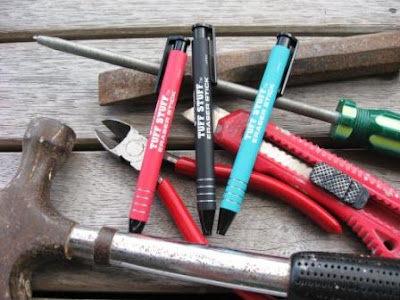 Well first off the Tuff Stuff seems a fairly typical mechanical stick eraser. Just like many a mechanical pencil, you push the top to advance the lead, oops, sorry, the eraser core, and you can push the core back inside the tip if necessary. I think this eraser stick counts as “pocket-safe”. The pocket clip top section pulls off to allow refilling with another eraser core. I’m not completely convinced by the security of the top section to the main body and I could imagine it coming loose after much use, but then this is not an expensive item , so just get another one if that ever happens.
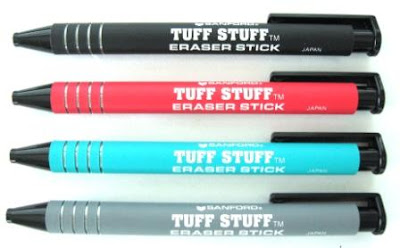 Now, the main event, the eraser core. Well it’s fairly narrow for a stick eraser, just under 4mm diameter (a bit over 1/8 inch). Mark pointed out to me that this diameter fits several mechanical pencil eraser cartridges (e.g. Faber-Castell). The compound appears to be a fairly hard vinyl, but don’t take the “vinyl” bit as gospel. I have noticed a bit of a general trend for eraser compounds to get harder as their diameter decreases, which does have some logic to it. Being a fairly narrow diameter the Tuff Stuff is well suited to smaller more precise erasing jobs, e.g. rubbing out an individual letter as opposed to whole lines of wording. The waste doesn’t readily twist up into strands so it’s a little messy, particularly on larger jobs. The eraser core often ends up with a dirty half-rubbed off stringy-blobby bit stuck on its tip (yes, that’s a technical term), which rather irritates me. (Dreadlocks for erasers?)
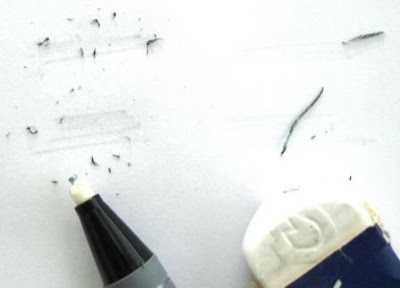 Overall then, I do like this eraser, but to date, Mars Plastic plus an eraser shield remains virtually unbeatable.
 The Uni Auto Eraser, model EH-100P, is made in Japan by Mitsubishi Pencil Company Ltd. Essentially it is a basic push top ratchet mechanical “pencil” that propels a 5mm diameter eraser rather than a piece of pencil lead. The mechanism really does feel and sound quite like an ordinary mechanical pencil mechanism.
 From my engineering and general office user background, I’ve traditionally mostly used medium and harder grades of lead, in the B to 2H sort of range. With these grades the Uni erasing power is adequate, but not exceptional. It doesn’t smear the pencil marks, but doesn’t quite seem to erase them as completely as some other erasers do, for example my trusty


 Posts
Posts


