Staedtler Rasoplast Eraser Review
I have previously reviewed the Staedtler Mars Plastic eraser, but Staedtler also have another similar eraser, the Rasoplast, which has been one of the mainstays of their product line for many years. So, time to put the Rasoplast to the test to see just how it differs from the Mars plastic.
Firstly then, at the risk of giving me preconceived ideas and thus skewing my results, I went to the Staedtler International website to look at these two erasers and see how Staedtler differentiate them. Well Staedtler describe these two erasers in fairly similar terms, but there are two significant differences in their website descriptions. Firstly the Mars Plastic description includes the claims “Practically residue-free erasing” and “Easy to remove eraser waste thanks to minimal crumbling”. The Rasoplast webpage makes no similar claims. The second key description difference is that the Mars Plastic is described as “Premium quality” and Rasoplast as “Comfort quality”.
Comfort quality? Comfort quality??? What the heck is that? Obviously we all like and need a bit of comfort, but what’s that got to do with erasers?
I have previously reviewed the Staedtler Mars Plastic eraser, but Staedtler also have another similar eraser, the Rasoplast, which has been one of the mainstays of their product line for many years. So, time to put the Rasoplast to the test to see just how it differs from the Mars plastic.
Firstly then, at the risk of giving me preconceived ideas and thus skewing my results, I went to the Staedtler International website to look at these two erasers and see how Staedtler differentiate them. Well Staedtler describe these two erasers in fairly similar terms, but there are two significant differences in their website descriptions. Firstly the Mars Plastic description includes the claims “Practically residue-free erasing” and “Easy to remove eraser waste thanks to minimal crumbling”. The Rasoplast webpage makes no similar claims. The second key description difference is that the Mars Plastic is described as “Premium quality” and Rasoplast as “Comfort quality”.
Comfort quality? Comfort quality??? What the heck is that? Obviously we all like and need a bit of comfort, but what’s that got to do with erasers?
 Other erasers are uncomfortable? Marketing mumbo-jumbo. I suppose maybe it’s some sort of counterpoint to the luxury brand concept? Staedtlers website is in many different languages, and I’d love to hear what the non-English sites say regarding this Premium and Comfort quality. For example, on the Italian language site, according to Google translate, the Mars Plastic is “premium quality”, but there’s no mention of the Rasoplasts quality, just that it's “improved formula”. Well there’s no mention of improved formula on the English site.
The Rasoplast comes in a couple of different sizes, like the Mars Plastic. For the test I bought a 526 B20 which is the larger size, about 21mm wide x 12mm thick x 63mm long. It has a protective sleeve like the Mars Plastic. On the sleeve I note “Made In Germany”, “Latex Free” and what appear to be recycling symbols in an Asian language. Latex free – said it before and I’ll say it again, fine if you want to tell us what it isn’t made from, but at least also tell us what it is made from. I note “PP” amongst the recycling symbols. That’s got me confused because that made me think of polypropylene, and I don’t think either the eraser or the sleeve are made from PP.

 The Staedtler Mars-head logo is embossed into the surface of the Rasoplast.
 The Rasoplast is definitely a harder compound than the Mars Plastic (as tested by the fingernail test method) and thus not surprisingly the Rasoplast bar is stiffer than Mars Plastic.
Right then, some actual eraser tests. All tests performed on ordinary photocopier paper. First up, woodcase coloured pencil. It’s very close, but a slight win to Mars Plastic.

Next woodcase HB, 4B and 6B graphite lead. Again, very close, but if I have to choose then I’d say Mars won HB and 6B, Rasoplast won 4B.

Lastly mechanical pencil lead, 0.5mm HB and 0.7mm B grade lead. No real difference.
 So, overall all then, very little difference in erasing power. As you might expect Rasoplast definitely feels harder and more abrasive in use, but it doesn’t seem to damage the paper surface. The eraser waste comes off differently, Rasoplast seems to form longer finer strings of waste and Mars Plastic definitely seems to get more graphite stains on it’s surface and thus require cleaning. Maybe Mars also tended to smear the graphite around on its first swipe a little more than Rasoplast did, but then it erased it on the second swipe. At the conclusion of the tests the amount of wear on the two erasers seemed fairly similar.

Final verdict – these two are quite close, but unless there was a significant economic advantage to Rasoplast, I’d stick with Mars Plastic.

 Shiploads of Viking Skjoldungen 400’s, numbers 1 through to 4. Not sure why these Vikings would use the (American) number system in the (European) HB system heartland.
 Lots of information on the box.
 Treesort high quality wood.
 Made from cedar trees.
  Phew, here’s a big one. So heavy you just about need the strength of Thor to lift it.
  Penol PL56 eraser. At 27 x 14 and 72mm long it’s a bit of a jumbo, nearly twice the size of Staedtler Mars Plastic 526 50, and it weighs a ton. Well 48 grams to be slightly more accurate. I had to put my nice new digital cailpers to some use so a quick bit of measurement and calculation tells me Penol PL56 is over 20% more dense than Mars Plastic. Heavy stuff. The texture makes it feel like there are plenty of fillers or additives in the compound.


 Staedtlers history is with woodcase pencils, and I get the impression woodcase pencils are still very important to them, maybe more important than mechanical pencils, and thus I have always assumed that if there was any choice required they would optimise their erasers for woodcase ceramic leads rather than polymer leads. On the other hand I don’t think there’s any argument that Pentels mechanical pencils are more important to them than their woodcase pencils. Not to imply their woodcase pencils aren’t important, but their mechanical pencils are a worldwide force whereas their woodcase pencils are basically Japan-only. Thus I am tempted to think that Pentels erasers would be optimised for mechanical pencil polymer leads, should there be any conflict between eraser requirements.
 Like many erasers the Pentel Hi-Polymer has a sliding cardboard sleeve. The eraser compound is white, and soft, noticeably a different white to Mars Plastic and definitely softer. Perhaps this softness might be an important consideration on thinner or more fragile papers, but in general use I found the softness a little annoying as it made the whole eraser flex and bend more when under pressure, and thus it felt a little less under control. As claimed, the eraser waste sticks together. I tried to compare the amount of waste produced and how well it stuck together with Mars Plastic but gave up. Too hard to be objective, but I am tempted to think the Pentel eraser wore down a little quicker than Mars Plastic.
 Mechanical Pencil polymer lead, 2B hardness.
  Woodcase Pencil HB and Mechanical Pencil HB.
 Woodcase Pencil 4B hardness.
  What did all that testing tell me? It told me that it’s pretty hard to tell these two erasers apart when it comes to erasing performance. Both do a great job on both woodcase and mechanical pencil leads. As expected, although still good, their worst performance was on the woodcase 4B lead. Smearing is always a little bit of a problem with such dark soft leads. This 4B test was the only one where I thought there was a little bit of a difference between the two erasers - it’s very close, but I did feel that Mars plastic did a slightly better job than Pentel Hi-Polymer on the 4B test. But very close, as I say.
 I’ve got to say I certainly got a surprise when I opened up the parcel containing them. I don’t know what I expected, but it wasn’t that.
  They are oversize compared to most normal erasers - the white one is “coarse” and the gray one “fine”. They are a gum eraser with grit. The gum is soybean oil based and there’s lots of grit in that white one, think “beach”, after you’ve done a bit of erasing and got some residue. Quite frankly, these erasers are way outside my experience and just plain strange to me. I really like the way they look, but they leave a little sandy trail wherever they go.
 Mars is a clear winner on woodcase and mechanical pencil HB graphite. Mars is a complete and utter loser on ballpoint ink. Black and red coloured pencil is fairly even but probably a win to Inkredible. Remember that Mars is basically removing (or not) the marking substance and leaving the paper alone, whilst Inkredible is basically abrading away the marking substance and the surface layer of the paper. I’m sure an experienced Inkredible user would make a much better job of it than me.
 So, its pretty obvious that Mars is better at things we normally regard as erasable, but Inkredible will remove all those other things normally thought of as non-erasable. But use with care!
 “Boston” is about the only legible marking on the eraser or its display box. It’s a cube, each face being about 24mm or just under 1 inch wide. Colour is a beige brown, and it appears to be natural rubber. The erasers sort of stick to their neighbours in the box, one face usually looks like its got a bit of a skin on if from being cooked or heated or cured or something. They appear slightly brittle as small pieces are missing from most of them – corner knocked off, bite taken out an edge, that sort of thing. I kind of like the look of it.
 I decided I’d risk my dollar and get one. I had read that crumbly art-gum erasers were quite good at erasing very soft dark pencil marks as the eraser crumbled and therefore didn’t smear the lead around like most firm erasers. Sounded interesting, a good theory, turned out to be complete rubbish. Well, maybe that's a bit harsh, what I really mean is this eraser is complete rubbish.
 I tried erasing some HB, 2B and 5B markings. It got worse as the B’s went up. Barely adequate at erasing HB, it was a smeary joke by 5B.
 In this photo, after erasing I have circled where the original marks to be erased were. On the left is the Boston, on the right is Staedtler Mars Plastic. No contest.
  Maybe they are not an eraser at all, but a lead blender or smearer for artists?


 Photo: The word “Cross” was written in ballpoint at the end of the eraser. Just the last 's' is left un-erased.


 Overall then it’s a bit of a mixture, with PVC-Free better under some circumstances and not under others. I have certainly added the Faber-Castell PVC-Free eraser to my armoury.
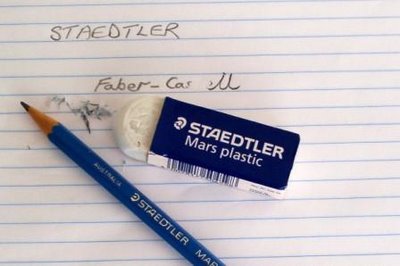 It is a reasonably large eraser which has some good and bad points. On the good side, you can get a firm grip on it which makes things easy if you have a lot of erasing to do, and you can erase an awful lot before you will need to buy a new one. So there’s slightly less need to panic during your exam when you suddenly realise you have to rub out half your wonderful design. On the bad side, whilst it starts out with nice square edges and a square end, you can’t really keep a sharp edge or fine point on this eraser so it is a bit of a blunt instrument. You definitely need an erasing shield if you have some fine erasing to do. Of course chopping the rounded end off the eraser is an option, and I have resorted to this every now and then.
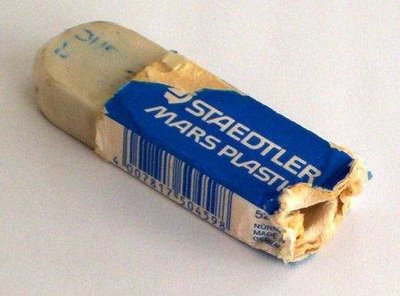 Speaking of the compound, as you erase away, the waste does twist itself up into long strands which are easily removed, just like Staedtler claim. They also claim it is good for removing scuff marks from vinyl floors, marks from light switches and wallpaper, cleaning nail files and a whole lot of other things. I can vouch for the first few – but no idea about the nail file! The compound is relatively odourless – I recall “smelly” erasers being very popular when I was a little fellow at primary school.


 Posts
Posts


