Here is the latest addition to the collection, the Ohto Piston Sharp SP-5. My birthday present to me :)
I first read of the Ohto Piston Sharp mechanical pencil in a Reddit post by 2nd_Astronaut. It immediately reminded of my Uni Returns M5-318 pencil. Unfortunately the Uni Returns has not fared well over the years. The elastomer grip is a sticky yucky mess. I have to store it wrapped in aluminium cooking foil to stop it contaminating its neighbours, and would have Kondo'ed the pencil long ago if it weren't for the unique mechanism. Well, after seeing the Piston Sharp I got on the sat-phone to contact 2nd in his space station and now I own another mechanical pencil with a returns mechanism, this time a much higher grade model, one that should last and not require aluminium foil... except of course for my hat which keeps the alien mind-control radio-waves at bay. The SP-5 I now have is metal and plastic, but there is also an SP-10 which is all metal.
So, to explain, the unique thing about this mechanism is that it both advances and retracts the lead via an otherwise normal push top ratchet mechanism. You do a small push or click to advance the lead, and a longer or bigger push or click to retract the lead. The Ohto Piston Sharp has clear markings on the barrel to indicate this - calling them Half Knock and Full Knock.
Once you understand the concept its not too hard to control the amount you push, and both pencils do have a partial resistance stop at the halfway point that you can feel.
The Uni Returns advances more lead per click than the Ohto Piston Sharp, so the Uni retraction mechanism will retract back 4 click advances worth of lead whilst the Ohto will retract back 3 clicks of lead.
Now, I'm sure this retraction mechanism must be patented by the inventor, so its use by two competing companies raises some questions. Did Ohto make the Returns for Uni? More likely I imagine would be that the inventor works for an OEM/ODM manufacturer which made both the Ohto and the Uni. Or the inventor has licensed both to use the patent. Or...???
The pocket clip attachment on the Piston Sharp is two spot welds to the body. Not particularly awe inspiring or aesthetically pleasing. But still, I am very glad to have added the Piston Sharp to the collection. Thanks 2nd.
Showing posts with label Uni. Show all posts
Tuesday, February 26, 2019
Friday, July 08, 2011
Mitsubishi Novelty Pencils
Germ sent me these ages ago. A bunch of NOS "novelty message" mechanical pencils made by Mutsubishi Pencil, i.e. Uni.
As mechanical pencils they are just lightweight aluminium bodied push top ratchet basic models. Their only branding is the Mitsubishi diamond logo on the body, and on the price sticker. 500 Yen.
There is some corrosion to the chrome plating on some of the pocket clips and tips, so I would guess they are about 15+ years old.
Each has a different message or pattern printed on it in English. They are those sort of messages which don't really sound right to native English speakers. I always assume these sort of things are verbatim translations of the original idea or thought in Japanese, and it just gets lost in translation.
As mechanical pencils they are just lightweight aluminium bodied push top ratchet basic models. Their only branding is the Mitsubishi diamond logo on the body, and on the price sticker. 500 Yen.
There is some corrosion to the chrome plating on some of the pocket clips and tips, so I would guess they are about 15+ years old.
Each has a different message or pattern printed on it in English. They are those sort of messages which don't really sound right to native English speakers. I always assume these sort of things are verbatim translations of the original idea or thought in Japanese, and it just gets lost in translation.
| Fantastic Sharp - Pretty flowers are perfumed in your room. |
| LOVELINESS - She's kind of a friend of mine. |
Labels:
Novelty Items,
Uni
Tuesday, October 12, 2010
Mitsubishi Pure Malt Pencil Review
Over the years of this blog I have made quite a few pencil-friends. Somehow, my correspondence with several of these pencil-friends rapidly turned to drinking...tea that is...so it should therefore come as no surprise that when I was first in contact with Ricardo from Portugal he quickly reminded me that I drink tea because my cultural heritage has strong roots back to Britain where, in the later 17th Century, tea was first popularised by the young Portuguese royal, Catherine of Braganza, the queen consort of King Charles II of England, Scotland and Ireland. But tea is not the only beverage of importance in the world, for instance there is also whisky, 'uisge beatha' - 'the Water of Life'. Far, far away from its origins in Scotland and Ireland, that Water also has its place in Japan, where they also take their tea seriously. One day as I sat at my wintery Antipodean window sipping tea, an email arrived from sunny summery Portugal, where Ricardo was no doubt shading himself as the ice clinked and the Water was cool and refreshing. Here then, is a guest review by Ricardo from Portugal on one of his favourite mechanical pencils, a pencil steeped in Watery tradition.
The subject of this review, the Mitsubishi Pure Malt Oak Wood Premium Edition [M5-5015] 0.5mm mechanical pencil is the top of the line and its appearance is striking. To me it is one of the most beautiful mechanical pencils I have ever seen and one of the best I've had the pleasure to use. It can easily be mistaken for one of those luxury products that cost a small fortune, it was marketed as such and really is a luxury product, but it is just not that expensive because there are no precious materials in its composition. The quality of construction is superb, Mitsubishi did an amazing job. I don't know if capped mechanical pencils like this were invented by Pentel or even if the Kerry was the first of this kind but I can only say without a doubt that Mitsubishi went a step further and improved it in a way I never thought possible.
With its short 2mm fixed sleeve this is a pencil suited for writing, drawing and sketching though it can also be used with some rulers and templates. As I said before the concept of this pencil is basically the same as the Pentel Kerry [P1035 AD], another favourite of mine (I actually carry a black one with me most of the time), but the Mitsubishi is way too precious to be carried around so it stays at home. By being slightly heavier and bigger than the Kerry, the Mitsubishi is a much better pencil in my opinion, also, because it is made out of wood it retains the warmth of the user’s body in a way plastic can’t. The wood polishing also provides a feeling to the touch very similar to silk without losing the wood's texture, so using it really is a very pleasant and unique experience. The grip has a concave design which works very well both for precise drawing and writing. There are no issues at all on griping this pencil, and just above the grip there's a metal ring which acts like a cap lock and works as a counter-weight when the pencil is used without the cap, moving the balance point to approximately 1cm above it, also, the only inscription on the pencil, the words Pure Malt, are embossed in it.
At first I was afraid the ring would be very inconvenient as it could dramatically reduce the grip area and could interfere in the way I usually hold my pencils, but I was wrong, it actually helps when I need to use the pencil to make quick sketches or cover large areas with graphite. On such occasions I usually hold the pencil 2 cm above the centre of the grip, with the M5-5015 that's 4cm above the tip of the sleeve, precisely where the ring is located so I just hold it by the ring to obtain an optimal positioning of the pencil between my fingers. The conical shape of the barrel is excellent for rotating the pencil in order to keep the lead sharp if needed (no need for a Kuru Toga Turn Engine here). As I said this pencil also has a "writing mode", when posted (with the cap on) the centre balance is moved 7.5cm above the tip of the sleeve which is excellent for this task. The cap doesn't wobble when posted and the pocket clip, besides being very well designed and beautiful, is very robust and secures the pencil very well to most pockets as it has some springiness. Naturally as a capped pencil it is totally pocket safe. This pencil is heavy, 26.3g posted, so conveniently the mechanism has a very short incremental advance which helps prevent lead breakage. With the lead fully retracted the first 2 clicks will advance it by 1mm and 10 clicks gives approximately 6mm of lead.
One final note goes to the presentation of this product, which is very complete. It comes sealed in a cellophane sleeve with a transparent acrylic tag attached to the pocket clip stating the model name, reference number, lead size, price and a couple more things written in Japanese which unfortunately I cannot read. The box is a matte black cardboard box with glossy imprints.
On the inside there's a detachable rectangular piece of corkwood cut with the shape of the pencil on one side and two identical ones on the other, meaning that two instruments can be stored in it. As well, an instruction manual and a small card written in Japanese that I assume to be some information about the Pure Malt line are also provided, along with a rectangular piece of black foam used to prevent the pencil from being loose when the box is closed.
I would dare to say the Mitsubishi Pure Malt Oak Wood Premium Edition [M5-5015] 0.5mm Mechanical Pencil is much more than a great writing instrument, as besides being one of the finest examples of Mitsubishi Pencil Co. Ltd. craftsmanship, it is also a work of art, of industrial design and an ode to mechanical pencils.
Technical specifications :
Composition : High quality chrome plated stainless steel, dark oak wood. Full metal mechanism and lead reservoir.
Size :
Capped: 135 x 12.8mm.
Pencil: 118 x 12.8mm.
Posted: 138 x 12.8mm.
Weight : 26.3g.
Lead Diameter : 0.5mm.
Eraser under the cap's push button.
(Text and images by Ricardo)
Thanks for this review Ricardo. I envy your artistic skill. Well, I guess its time for some more Water, be it brewed or distilled.
Mitsubishi Pure Malt Oak Wood Premium Edition [M5-5015] - 0.5mm Mechanical Pencil Review
The Mitsubishi Pure Malt Oak Wood Premium Edition range of writing instruments were released on Monday, October 29, 2001 in Japan by the Mitsubishi Pencil Co. Ltd as the high-end series of the Mitsubishi Oak Wood line of writing instruments. Available only in the Land of the Rising Sun this line of products is composed of ballpoint pens, a multi function pen, 0.5mm mechanical pencils and a 2mm lead holder. Here's a description of the entire line:- Mitsubishi Pure Malt Oak Wood Premium Edition [M5-5015] 0.5mm mechanical pencil.
- Mitsubishi Pure Malt Oak Wood Premium Edition [SS-5015-P10] 1.0mm ballpoint pen.
- Mitsubishi Pure Malt Oak Wood Premium Edition [MH-3005] 2.0mm lead holder.
- Mitsubishi Pure Malt Oak Wood Premium Edition Multi Pen [MSE-3005] 0.5mm mechanical pencil and 0.7mm black & red ball point pen.
- Mitsubishi Pure Malt Oak Wood Premium Edition [M5-2005] 0.5mm mechanical pencil.
- Mitsubishi Pure Malt Oak Wood Premium Edition [SS-2005] 0.7mm ballpoint pen.
The subject of this review, the Mitsubishi Pure Malt Oak Wood Premium Edition [M5-5015] 0.5mm mechanical pencil is the top of the line and its appearance is striking. To me it is one of the most beautiful mechanical pencils I have ever seen and one of the best I've had the pleasure to use. It can easily be mistaken for one of those luxury products that cost a small fortune, it was marketed as such and really is a luxury product, but it is just not that expensive because there are no precious materials in its composition. The quality of construction is superb, Mitsubishi did an amazing job. I don't know if capped mechanical pencils like this were invented by Pentel or even if the Kerry was the first of this kind but I can only say without a doubt that Mitsubishi went a step further and improved it in a way I never thought possible.
![]() |
| Mitsubishi Pure Malt Mechanical Pencil & Pentel Kerry |
With its short 2mm fixed sleeve this is a pencil suited for writing, drawing and sketching though it can also be used with some rulers and templates. As I said before the concept of this pencil is basically the same as the Pentel Kerry [P1035 AD], another favourite of mine (I actually carry a black one with me most of the time), but the Mitsubishi is way too precious to be carried around so it stays at home. By being slightly heavier and bigger than the Kerry, the Mitsubishi is a much better pencil in my opinion, also, because it is made out of wood it retains the warmth of the user’s body in a way plastic can’t. The wood polishing also provides a feeling to the touch very similar to silk without losing the wood's texture, so using it really is a very pleasant and unique experience. The grip has a concave design which works very well both for precise drawing and writing. There are no issues at all on griping this pencil, and just above the grip there's a metal ring which acts like a cap lock and works as a counter-weight when the pencil is used without the cap, moving the balance point to approximately 1cm above it, also, the only inscription on the pencil, the words Pure Malt, are embossed in it.
At first I was afraid the ring would be very inconvenient as it could dramatically reduce the grip area and could interfere in the way I usually hold my pencils, but I was wrong, it actually helps when I need to use the pencil to make quick sketches or cover large areas with graphite. On such occasions I usually hold the pencil 2 cm above the centre of the grip, with the M5-5015 that's 4cm above the tip of the sleeve, precisely where the ring is located so I just hold it by the ring to obtain an optimal positioning of the pencil between my fingers. The conical shape of the barrel is excellent for rotating the pencil in order to keep the lead sharp if needed (no need for a Kuru Toga Turn Engine here). As I said this pencil also has a "writing mode", when posted (with the cap on) the centre balance is moved 7.5cm above the tip of the sleeve which is excellent for this task. The cap doesn't wobble when posted and the pocket clip, besides being very well designed and beautiful, is very robust and secures the pencil very well to most pockets as it has some springiness. Naturally as a capped pencil it is totally pocket safe. This pencil is heavy, 26.3g posted, so conveniently the mechanism has a very short incremental advance which helps prevent lead breakage. With the lead fully retracted the first 2 clicks will advance it by 1mm and 10 clicks gives approximately 6mm of lead.
One final note goes to the presentation of this product, which is very complete. It comes sealed in a cellophane sleeve with a transparent acrylic tag attached to the pocket clip stating the model name, reference number, lead size, price and a couple more things written in Japanese which unfortunately I cannot read. The box is a matte black cardboard box with glossy imprints.
On the inside there's a detachable rectangular piece of corkwood cut with the shape of the pencil on one side and two identical ones on the other, meaning that two instruments can be stored in it. As well, an instruction manual and a small card written in Japanese that I assume to be some information about the Pure Malt line are also provided, along with a rectangular piece of black foam used to prevent the pencil from being loose when the box is closed.
I would dare to say the Mitsubishi Pure Malt Oak Wood Premium Edition [M5-5015] 0.5mm Mechanical Pencil is much more than a great writing instrument, as besides being one of the finest examples of Mitsubishi Pencil Co. Ltd. craftsmanship, it is also a work of art, of industrial design and an ode to mechanical pencils.
Technical specifications :
Composition : High quality chrome plated stainless steel, dark oak wood. Full metal mechanism and lead reservoir.
Size :
Capped: 135 x 12.8mm.
Pencil: 118 x 12.8mm.
Posted: 138 x 12.8mm.
Weight : 26.3g.
Lead Diameter : 0.5mm.
Eraser under the cap's push button.
![]() |
| Mitsubishi Pure Malt Mechanical Pencil - writing mode - cap posted |
![]() |
| Mitsubishi Pure Malt Mechanical Pencil - sketching mode - cap unposted |
(Text and images by Ricardo)
Thanks for this review Ricardo. I envy your artistic skill. Well, I guess its time for some more Water, be it brewed or distilled.
Labels:
Guest Post,
Uni
Tuesday, March 30, 2010
Uni Alpha-Gel Mechanical Pencil Review
There are a few different varieties of the Uni Alpha Gel mechanical pencil – originals, slimlines, shakers, etc. I never planned on getting one because they aren’t available in my part of the world and their main feature is a large squishy gel grip…something I am not usually enamoured with. But in a very polite way Isu from Japan frequently asked me if I had a Uni Alpha Gel, and did I know “...its gel grip is the exact same consistency as Haribo Gummi Bears?” Well, I hadn’t ever heard of Haribo Gummi Bears, obviously another thing we don’t have down my way, but Isu’s sweet tooth got to me and eventually I ordered an Alpha Gel mechanical pencil. A Uni Alpha Gel HD Shaka Shaka M5-618GG 1P chrome green mechanical pencil to be precise.
The bright shiny chrome green upper body and metallic chrome fittings combine to make a rather striking and attractive looking pencil.
The Alpha Gel weighs in at 18grams and in the hand it feels about the weight you would expect for a largish plastic mechanical pencil. I must say that when you first pick it up or wave it around a bit in your hand the movement of the internal shaker weight seems more obvious than on many other shakers, and more noisy when the weight hits the end stops.
I have read that the gel grips are slightly different formulations and consistencies on some of the models. (Unlike Gummi Bears?) My creamy white grip is quite soft and squishy, flowing and moulding under normal finger pressure. I wouldn’t be surprised if the grip has some ‘memory’ and becomes permanently deformed after extended use, but I haven’t used it long enough to say for sure. I have also read on some other reviews that people have had problems with the grip tearing. It didn’t happen to me, but I take extra care with my review pencils because I want to try and keep them in ‘as new’ condition for my collection. I could see the Alpha Gel grip being very susceptible to damage if stored in a pencil case and rolling around with other pencils and items. That’s just plain ole askin’ for trouble. Anyway, it does seem likely to me that the Alpha Gel grip is not particularly robust or durable. I’d also suspect that the grip won’t stay that nice milky white colour for too long in real-world conditions.
Like most gel grips it is of larger than average diameter – about 13mm or 1/2inch to be a little more specific.
Not surprisingly the Shaka Shaka is a shaker mechanism pencil. The instructions for its use were a little beyond me, but you can operate it as an ordinary push top ratchet mechanism, with ten clicks getting you 7mm of 0.5mm lead, or you can shake away and operate it with the shaker mechanism. The push top button can also be fully depressed to lock the shaker mechanism so it doesn’t operate. This doesn’t just lock the shaker, it also makes the pencil non-operational as the lead is no longer held by the chuck and thus can be pushed back up inside the sleeve. Some might say that the lock is not 100% effective, as if you give it a really good shaking you will get a little bit of lead advancement. However the lead is not gripped and it can just be pushed straight back in.
The shaker is readily activated, possibly almost too easily, but that’s a matter of subjective opinion.
I have long since reconciled myself to the fact that if you write a blog, at some stage you are going to end up looking stupid, only the frequency and degree of stupidity will vary, so now for the embarrassing bit. I feel really certain that when I first got my Alpha Gel that the lead sleeve was retracted, and the first push on the top button extended the sleeve out. Now though it is a non-retractable fixed sleeve. So surely it can’t have been retracted when I first got it? But my mind is convinced. Garrrr!!!….I must be going mad. However I will ignore the madness and say that the Uni Alpha Gel has a fixed non-retractable 3mm lead sleeve.
• Best Points – That chrome green finish really is good looking.
• Not So Good Points – Lead sleeve not retractable, questionable durability.
• Price Range – Low.
• Does this pencil make it into the Top 5? - No.
Dimensions – Length 145mm, diameter 13mm at grip. Balance point about 70mm up from the tip.
Note: The alpha symbol is sometimes mistaken and written as oxy and thus the pencil mistakenly called oxy-gel, uni oxy gel or oxi gel or other names along those lines.
There are a few different varieties of the Uni Alpha Gel mechanical pencil – originals, slimlines, shakers, etc. I never planned on getting one because they aren’t available in my part of the world and their main feature is a large squishy gel grip…something I am not usually enamoured with. But in a very polite way Isu from Japan frequently asked me if I had a Uni Alpha Gel, and did I know “...its gel grip is the exact same consistency as Haribo Gummi Bears?” Well, I hadn’t ever heard of Haribo Gummi Bears, obviously another thing we don’t have down my way, but Isu’s sweet tooth got to me and eventually I ordered an Alpha Gel mechanical pencil. A Uni Alpha Gel HD Shaka Shaka M5-618GG 1P chrome green mechanical pencil to be precise.
The bright shiny chrome green upper body and metallic chrome fittings combine to make a rather striking and attractive looking pencil.
The Alpha Gel weighs in at 18grams and in the hand it feels about the weight you would expect for a largish plastic mechanical pencil. I must say that when you first pick it up or wave it around a bit in your hand the movement of the internal shaker weight seems more obvious than on many other shakers, and more noisy when the weight hits the end stops.
I have read that the gel grips are slightly different formulations and consistencies on some of the models. (Unlike Gummi Bears?) My creamy white grip is quite soft and squishy, flowing and moulding under normal finger pressure. I wouldn’t be surprised if the grip has some ‘memory’ and becomes permanently deformed after extended use, but I haven’t used it long enough to say for sure. I have also read on some other reviews that people have had problems with the grip tearing. It didn’t happen to me, but I take extra care with my review pencils because I want to try and keep them in ‘as new’ condition for my collection. I could see the Alpha Gel grip being very susceptible to damage if stored in a pencil case and rolling around with other pencils and items. That’s just plain ole askin’ for trouble. Anyway, it does seem likely to me that the Alpha Gel grip is not particularly robust or durable. I’d also suspect that the grip won’t stay that nice milky white colour for too long in real-world conditions.
Like most gel grips it is of larger than average diameter – about 13mm or 1/2inch to be a little more specific.
Not surprisingly the Shaka Shaka is a shaker mechanism pencil. The instructions for its use were a little beyond me, but you can operate it as an ordinary push top ratchet mechanism, with ten clicks getting you 7mm of 0.5mm lead, or you can shake away and operate it with the shaker mechanism. The push top button can also be fully depressed to lock the shaker mechanism so it doesn’t operate. This doesn’t just lock the shaker, it also makes the pencil non-operational as the lead is no longer held by the chuck and thus can be pushed back up inside the sleeve. Some might say that the lock is not 100% effective, as if you give it a really good shaking you will get a little bit of lead advancement. However the lead is not gripped and it can just be pushed straight back in.
The shaker is readily activated, possibly almost too easily, but that’s a matter of subjective opinion.
I have long since reconciled myself to the fact that if you write a blog, at some stage you are going to end up looking stupid, only the frequency and degree of stupidity will vary, so now for the embarrassing bit. I feel really certain that when I first got my Alpha Gel that the lead sleeve was retracted, and the first push on the top button extended the sleeve out. Now though it is a non-retractable fixed sleeve. So surely it can’t have been retracted when I first got it? But my mind is convinced. Garrrr!!!….I must be going mad. However I will ignore the madness and say that the Uni Alpha Gel has a fixed non-retractable 3mm lead sleeve.
There is a small white occasional use only eraser under the top button. I quite like the pepper-pot arrangement of holes in the top button. As expected you pull the eraser out to refill the lead magazine.
The pocket clip is very good - very springy with an interesting clear plastic tip that catches the barrel colour or not, depending on your angle of view.
Whilst I wouldn’t say no to a Gummi Bear or Jelly Baby, I’m really more of a Milk Bottles type of person. Many Milk Bottles perished preparing this article.
• Not So Good Points – Lead sleeve not retractable, questionable durability.
• Price Range – Low.
• Does this pencil make it into the Top 5? - No.
Dimensions – Length 145mm, diameter 13mm at grip. Balance point about 70mm up from the tip.
Note: The alpha symbol is sometimes mistaken and written as oxy and thus the pencil mistakenly called oxy-gel, uni oxy gel or oxi gel or other names along those lines.
Labels:
Uni
Thursday, December 17, 2009
Kuru Toga 0.7
Whats wrong with this Kuru Toga picture?
Here's a hint.
Uni Kuru Toga 0.5mm mechanical pencil with 0.7mm lead refills?
Way up there in Japan, Isu has been at it again. Out with his micro tools, modifying away, trying to make ever fatter Kuru Toga's. Thanks Isu, a unique addition to the collection.
Here's a hint.
Uni Kuru Toga 0.5mm mechanical pencil with 0.7mm lead refills?
Way up there in Japan, Isu has been at it again. Out with his micro tools, modifying away, trying to make ever fatter Kuru Toga's. Thanks Isu, a unique addition to the collection.
Labels:
Uni
Monday, October 05, 2009
Uni Shift 1010 Mechanical Pencil Review
What to do about the sharp pointy end of the mechanical pencil? That’s a problem that has long exercised the minds of the designers and users of mechanical pencils. Many just ignore it and have a fixed sharp tip. Others protect the sharp end by having sliding retractable lead sleeves, or caps, or double action vanishing points, or extendable protective over-sleeves, or…well the list goes on. The subject of this review, Mitsubishi Pencil Co’s Uni Shift 1010 mechanical pencil uses something akin to a vanishing point mechanism to protect the lead sleeve when it is not in use.
When retracted (storage or carry mode), the Uni Shift looks like this.
When in carry mode, the push top button does not operate so you cannot accidently advance any lead. The lead sleeve is retracted back in carry mode, but it’s tip is only just inside the front section, and if you had recently advanced the lead then it can be left protruding out the end of the front section. This is not a major problem, but it does mean it can potentially mark the inside of whatever you put your Shift into, and to be honest, I am slightly disappointed Uni didn’t eliminate this matter by having the sleeve retract just a fraction further back.
It doesn’t take long to get used to the idea of pushing the body section up or down to advance or retract the tip, but the little twist to lock it into position is slightly problematic. Whilst it is a fairly definite and positive action, it is possible to only half-twist, particularly when advancing the tip. This locks the tip in the writing position, but not securely, and a little later you can inadvertently have it unlock and spring back into carry mode whilst you idly move the pencil about in your hands when not actually writing. I accept that this matter is within the control of the pencil user, and it’s only a minor point, but I am again slightly disappointed that Uni somehow didn’t address this in the design phase.
The pocket clip is a rather plain but springy and functional chromed metal.
The lead diameter is also marked on the central body core and visible when in carry mode.
Note the sticker advertising this mechanical pencil is factory loaded with Uni Nano Dia leads.
Overall then the Uni Shift is a very nice mechanical pencil and worth having in a collection.
Thanks Isu.
What to do about the sharp pointy end of the mechanical pencil? That’s a problem that has long exercised the minds of the designers and users of mechanical pencils. Many just ignore it and have a fixed sharp tip. Others protect the sharp end by having sliding retractable lead sleeves, or caps, or double action vanishing points, or extendable protective over-sleeves, or…well the list goes on. The subject of this review, Mitsubishi Pencil Co’s Uni Shift 1010 mechanical pencil uses something akin to a vanishing point mechanism to protect the lead sleeve when it is not in use.
When retracted (storage or carry mode), the Uni Shift looks like this.
When extended or in writing mode it looks like.
The change is brought about by pushing the upper body section forward which in turn pushes the lead sleeve out of the fixed front section. Note the change in overall length of body above the grip, and the position of components, but there is only a minute change in total overall length.
At the top and bottom of the body sections travel you twist it just a few degrees to lock it into position. When in carry mode, the push top button does not operate so you cannot accidently advance any lead. The lead sleeve is retracted back in carry mode, but it’s tip is only just inside the front section, and if you had recently advanced the lead then it can be left protruding out the end of the front section. This is not a major problem, but it does mean it can potentially mark the inside of whatever you put your Shift into, and to be honest, I am slightly disappointed Uni didn’t eliminate this matter by having the sleeve retract just a fraction further back.
It doesn’t take long to get used to the idea of pushing the body section up or down to advance or retract the tip, but the little twist to lock it into position is slightly problematic. Whilst it is a fairly definite and positive action, it is possible to only half-twist, particularly when advancing the tip. This locks the tip in the writing position, but not securely, and a little later you can inadvertently have it unlock and spring back into carry mode whilst you idly move the pencil about in your hands when not actually writing. I accept that this matter is within the control of the pencil user, and it’s only a minor point, but I am again slightly disappointed that Uni somehow didn’t address this in the design phase.
The lead sleeve is a 4mm long thin pipe suitable for drafting work. I do note that the Uni Japanese website generally emphasises drafting pencils for precise writing of characters, rather than for any traditional drafting work. Although the sleeve is retractable it is not a sliding sleeve. So, when extended it is fixed in position and does not slide back up inside as the lead wears down. Having said that, it isn’t a fixed sleeve in the traditional sense and there is a very small amount of wobble, which ultra precise type users who demand rock-solid instruments will not find acceptable. Of course the actual sliding upper body section also has some wobble on the central shaft, but that shouldn’t really concern anyone.
The lead advance mechanism is a standard push top ratchet. As mentioned above it only functions when the pencil is in writing mode. Ten clicks of the mechanism will get you 6mm of the 0.5mm lead. The Shift is available in other lead diameters. As well as the black and red 0.5mm M5-1010 models shown in most pictures in this review, I also have the 0.7mm model, i.e. M7-1010, as below. It looks rather nice in silver and orange.
There is a small eraser under the top cap. Black. Very cool.
You pull the eraser out to access the lead refill magazine. The pocket clip is a rather plain but springy and functional chromed metal.
The grip is a diamond cut metal section. It doesn’t feel too abrasive on your skin and provides a good secure grip. It is a round grip, and straight sided, so you can hold anywhere and twirl as much as you like.
Weighing in at about 19g the Uni Shift is a medium weight mechanical pencil and it is balanced towards the tip. The weight, balance and looks all combine to make the Shift look and feel pretty good in the hand.
Markings on the pencil are “Uni Shift” and the lead size on the upper body section. “Japan” is also moulded in small letters on the upper body section. The lead diameter is also marked on the central body core and visible when in carry mode.
Note the sticker advertising this mechanical pencil is factory loaded with Uni Nano Dia leads.
Overall then the Uni Shift is a very nice mechanical pencil and worth having in a collection.
- Best Points – The Shift mechanism makes an interesting change.
- Not So Good Points – Not properly locking the mechanism.
- Price Range – Low.
- Does this pencil make it into the Top 5? - No.
Thanks Isu.
Labels:
Uni,
Vanishing Point Mechanism
Saturday, September 19, 2009
Uni Kuru Toga Mechanical Pencil High Grade Type M5-1012
To be honest, I’m not really sure of the proper name for this mechanical pencil. First there was only the Kuru Toga, model M5-450 1P (or M3-450 1P in 0.3mm) but now there is a second model of mechanical pencil using the Kuru Toga ‘turn engine’, the M5-1012 1P. This new model is variously referred to as ‘high-grade’, ‘high specification’ or ‘2nd generation’, but high-grade seems to be the most common translation of Japanese websites so I’ll run with that. I guess it makes the 450 series Kuru Togas ‘original’. This article is mostly a quick comparison with the original Kuru Toga rather than a proper stand alone review, and should be read in conjunction with my original Kuru Toga posting.Kuru Toga High Grade
At a quick glance the High Grade and the Original Kuru Toga don’t share many components other than the name and presumably the same internal Kuru Toga “turn engine” mechanism. You can see the differences in the pictures below.
The tip sections look similar but they are not the same.
Different grip sections, main bodies, pocket clips, end sections, etc.
Clearly the extra metal components of the High Grade mean it should last a little longer.At 15g the High Grade Kuru Toga is a medium weight mechanical pencil and about 5g heavier than the Original, but really neither of them are going to weigh your hand down. I expected the High Grade to be balanced towards the tip but it isn’t really, which was a little disconcerting until I got used to my expectation being incorrect.
The metal grip section of the High Grade is sculpted like the Original, but it’s a very slippery surface finish and I think the clear plastic of the Original actually provides a better grip.
Lead advance is achieved by a normal push top ratchet mechanism. Ten clicks will get you about 6mm of 0.5mm lead.
It’s only small and emergency use, but I really like the black eraser. Black pencil, black eraser, full marks to Uni.
The High Grade Kuru Toga is simple marked Kuru Toga.
Is the Kuru Toga a draughting mechanical pencil? (Or drafting pencil as much of the English speaking world says.) I have seen it advertised on some websites as a drafting pencil, so let’s examine that idea. The lead sleeve is a thin metal pipe, but only about 2.75mm long. That’s a bit on the short side - 4mm is the usual length for mechanical pencils designed as drafting pencils. Quite a few people are very demanding of their precision technical mechanical pencils and the Kuru Toga has two features which might not satisfy exacting standards. Firstly the tip section steps out to full diameter quite quickly and I’m sure some folk would say it interferes with their line of sight to the lead. Secondly the turn engine means there is a small amount of vertical movement of the lead as you press down on the paper. It’s only a very small movement, but it’s different from normal lead cushioning and I know from previous comments that some of you will not find this acceptable. When you use a 0.5mm (or 0.3mm) pencil for drafting you usually hold it perpendicular to the paper so that the lead diameter is the width of the line. If you hold your pencil perpendicular to the paper then you never get a sharp or chisel point on your lead and the whole concept of the turn engine has no purpose, it’s a nullity. Lastly, as far as I can see, Mitsubishi Pencil don’t claim it as a drafting pencil. So, for my money, there is no question, the Kuru Toga is not a drafting pencil. It may have the general form of a mechanical drafting pencil, but it is not a drafting pencil.Another question – How long will the turn engine last? The turn engine is a mechanism of toothed plates engaging and disengaging, so obviously there must be some wear, and thus the kuru toga will have a life expectancy of x-million operations before the teeth wear and jam or just don’t turn anymore. How many is x?
- Best Points – Turn, turn, turn.
- Not So Good Points – Slippery grip.
- Price Range – Low.
- Does this pencil make it into the Top 5? - No.
Labels:
Uni
Thursday, April 24, 2008
Uni Kuru Toga
Uni Kuru Toga
OK, here’s a new one. Fresh out of the postie’s satchel, sent to me by my friend in Japan. I believe it’s a relatively new release on the Japanese market. It is the Uni “Kuru Toga” (M5-450 1P) mechanical pencil by Mitsubishi Pencil.
What does Kuru Toga mean? Well, apparently ‘Kuru’ is a sort of Japanese sound symbolism that we don't really have in English, but anyway it's associated with ‘turning’, and ‘Toga’ is the shortened form of ‘togaru’ which means ‘be sharpened’. The pencil itself has 'Kuru Toga Engine' printed on it.
Quite simply, the idea is that as you write the lead is auto-rotated around so that it maintains a sharp point and doesn’t get a chisel edge on it, leading to changing line thicknesses as you write or if you rotate the pencil in your hand. The pencil comes with a 12 page little cartoon style A6 size booklet explaining the virtues of Kuru Toga. Now I don’t read Japanese, so no idea what it actually says, but here it is reproduced in full, so I think we can all get the general idea. I scanned it lay flat, so six scans of A5 size.

I haven’t pulled the mechanism apart but clearly the concept is that the lead-holding jaws are mounted on a toothed clutch. Each time you press down to write the clutch teeth engage and the sliding faces cause the lead to be rotated around a fraction.
The trick then is the constant lifting and pressing back down as you write. The clutch is springing apart and back together, rotating each time. Now this is a 0.5mm pencil, so a chisel edge on the lead isn’t a huge deal, but still, it’s a heck of an idea. There is also a 0.3mm version. Now that would be a sharp point! Still, Uni extol the virtues of the constantly sharp point for neat precise writing, and a reduction in lead breakage.Right then. Does it actually work?
Well… yes, it does. Whether you really care, well…that’s another matter.
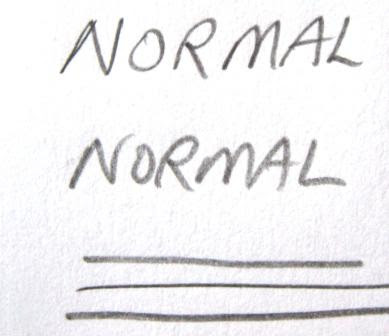
So, first thing I did was get an ordinary pencil (Lamy 2000) and the Kuru Toga and make sure they had good clean leads with a square end. Start writing. Clearly normal started out a thin line and got progressively thicker as the end wore down to a chisel point. I did not rotate the pencil in my hand. The picture below shows ‘normal’ at the start and then ‘normal’ after a line of writing. At the bottom of the picture are three lines – the middle one is at the start, the one above and below are after the chisel edge has been worn on the lead. So, we can see what happens normally, things get thicker as the lead wears. (Phew, it's like rocket-science)
Now Kuru Toga. Below is a picture of ‘normal’ and ‘kuru’ after a couple of lines writing with each. Normal has worn to a chisel point and makes thicker lines. Kuru stays sharp.
To recap – here’s the 3 line test for both, shown together. For each, the middle line is the start with a fresh new lead, the lines above and below are drawn after a couple of lines of writing with that lead.
One thing I did note with Kuru Toga was that it always felt slightly scratchy on the paper. You know how when you pick up a pencil and by chance you start writing with the sharp side or tip of the chisel point and it digs or catches a little on the paper. Well, that’s basically what kuru is doing, always presenting the sharp edge to the paper, so it’s not the smoothest of writing experiences. Still, nothing to get too hung up over.You know, to some extent it almost doesn’t matter how well this pencil works or not, it’s the thought that counts. These sorts of ideas and innovations are occurring in Japan, not elsewhere. Just look at that booklet! This is clearly the product of a design team and company that really think about their product and their market, see a future, try something new, move forward, and not just think, “Oh, it’s a pencil, we’ll always sell them, but there’s nothing much ever going to happen with pencils! They’re a cash-cow, just milk them.”
Link to the new Uni Kuru Toga High Grade
Labels:
Uni
Subscribe to:
Posts (Atom)


