A few months ago Pentel Ain won the inaugural Lead Cup so it’s time to do an official review of Pentel leads.
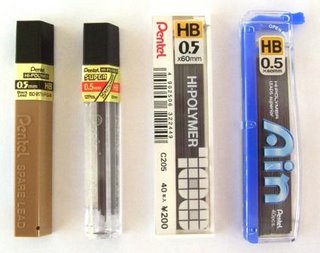
Pentel offer a great variety of graphite leads of many different thickness', hardness grades, quality levels, packaging, etc. For example in ordinary mechanical pencil refill leads they offer 0.3, 0.5, 0.7, 0.9 and 1.3mm thickness leads. In 1.3mm they offer hardness 2B, B, HB and H, but in 0.5mm leads the range of hardness offered expands to 4B through to 6H, including an F grade. They label their apparent quality levels as ‘Hi-Polymer’, ‘Super Hi-Polymer / Ain’, and ‘Premium Hi-Polymer’. Despite the name ‘Premium Hi-Polymer’ it appears that ‘Super Hi-Polymer / Ain’ is their top quality level lead.
As far as I can tell, Ain is just a marketing brandname, the Super Hi-Polymer leads are sold in a variety of containers, quantities per container (e.g. 12, 30 or 40 leads per container) and so on, some as ‘Super Hi-Polymer’ and some as ‘Ain’. All in all there’s an awful lot of apparent choice.
I wasn’t really sure about how to review leads, so I decided to spend a week writing with a selection of different hardness Ain 0.5mm leads. For comparison I also used Pentel Hi-Polymer 0.5mm HB lead. In theory the Ain leads are superior to Hi-Polymer.
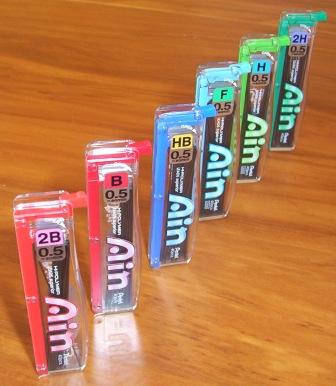
Well let’s get a few of the technicalities out of the way. Reliving the glory days of The Lead Cup, I put a few sticks of lead to the strength test. It was a clear victory, Ain HB is miles stronger than Hi-Polymer HB, so the cynic in me is wrong, there really must be two different formulations. Right then, what about between the hardness grades of Ain? There was a small but clear difference – as you might suspect, 2H was stronger than 2B.
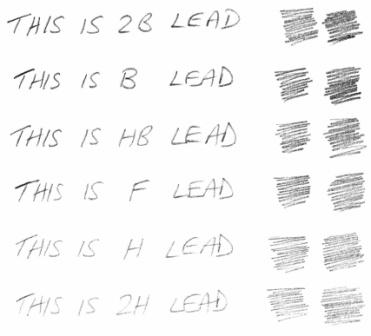
So that’s strength, what about darkness? Just how much difference is there between the hardness grades? Basically I don’t think there is a lot of difference from one grade to the next on the scale, but if you skip a few out then there definitely is a difference in darkness. Anyone could tell 2B from 2H but its pretty difficult spotting the difference between 2B and B. I think they could probably delete every second hardness and not really affect anyone.
I recently had some difficulty with the diameters of some 0.7mm leads, so since my micrometer was handy I ran it across these 0.5mm leads. Grades 2B, B, HB, F, H, and 2H of Ain were all in the 0.565 to 0.57mm range, and the Hi-Polymer HB was 0.56mm. Strictly speaking, if you were correctly rounding to one decimal place, these are all 0.6mm leads, not 0.5mm.
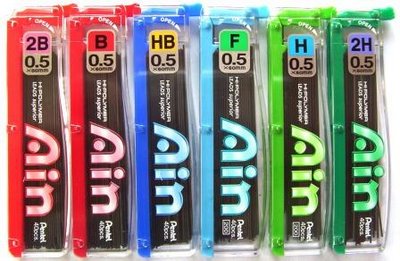
I must admit I’m rather taken by the Ain packaging. I like the clear sided gently curving container and the bright printed graphics.
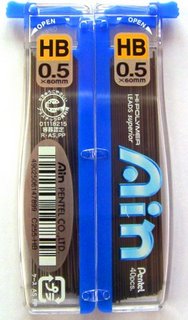
There appears to be a colour coding system in use for the spine and lever top - varying shades of red for the B grades of lead, greens for the H grades, and blues for the HB and F mid-grades. My containers have quite an array of fine print on the back of them relating to plastic recycling. There is some difference in the container markings, indicating it’s a changing thing at Pentel. The F container has no recycling information on it, but all the others do. Now I’m not much of an expert, but as far as I can tell, the marks indicate they are recyclable, and are in fact made from some recycled material – polypropylene and whatever ‘AS’ is. I am guessing its some sort of acrylic-styrene, but I can’t find any reference to what the code ‘AS’ stands for in the plastics recycling schemes. But then again I don’t read Japanese.
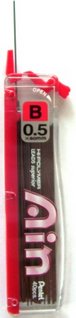
There are 40 pieces of 60mm long lead in each Ain container. You flip the top open by pressing down on the lever with your thumb. Then you give the container a bit of a shake to dispense some lead. Actually this is not really the best. Sometimes you have to give it quite a good shake to get some leads out, and you can get one, or 2 or 3 at a time. Putting surplus leads back in can also be a bit fiddly. I get the impression it’s supposed to be a design that dispenses leads individually, but often lets a few others sneak out.
Now, what about actually writing with the leads! First up I put on my testing hat and did a blind test on the Hi-Polymer HB and Ain HB. Could I tell a difference when just writing under ordinary circumstances? Well, basically no. I had Ain in one pencil and Hi-Polymer in another and swapped them around a few times. I couldn’t tell the difference. Ain was of course stronger, it was undefeated in the strength tests of the Lead Cup, but that doesn’t mean Hi-Polymer was weak and breaking all the time, because it wasn’t. Ain has exceptional strength, but Hi-Polymer is certainly strong enough for normal use.
About 10 years ago I did a year long part-time course in quality assurance. I always remember the time we did a class test on Coke vs Pepsi. This is apparently a standard technique in the food industry. You give the test group three samples each – 2 of one thing and 1 of another and ask them to pick the odd one out. So, my class of 20 or so students were each given three little taster cups of cola – 2 were Coke and 1 was Pepsi. I mean how hard could it be? They taste completely different, don’t they? Well, statistically speaking my class couldn’t tell them apart. Pretty much 1/3rd of the class chose sample A as the odd one out, 1/3rd chose B and 1/3rd C. The lecturer said he had never had a class that could tell them apart, so as much as I can’t believe it, it appears there is no difference between Coke and Pepsi to the taste-buds of the general public. Crazy stuff.
Now note that I said general public. In my class there were two employees from the local Coca-Cola bottling plant. One worked in the laboratory and the other was a genuine ‘taste-tester’. The lady from the laboratory could easily pick the Pepsi by taste, we all watched as she did the three way test a few times and could immediately choose the odd-one out. Then it was the taste-testers turn. He was of course stunned at how useless we all were, a bunch of morons unable to tell Coke from Pepsi. I kid you not, he could tell them apart by sight from a few metres away. Blindfolded he could tell them apart by listening to them – the different levels of carbonation making different bubble sounds! Blindfolded and fingers in ears he could sniff them and tell them apart by smell. So, I’m sure the lead experts at Pentel can tell Hi-Polymer from Ain in the blink of eye, but as for the rest of us….
Well that’s Hi-Polymer out of the way, what about the different grades of Ain? I spent the rest of the week using two identical pencils, one with Ain HB in it and the other with a different grade – 2H, F or 2B.
All the grades are good smooth writing. 2B was slightly smoother than the harder grades, particularly 2H, and if you rotated the pencil to start on a new part of the leads chisel point then you can tell that the harder the grade the more it dug into the paper and took longer to wear down. When I was using the 2H lead I did keep wanting to press harder to darken things up. I put a page of mixed 2H and HB writing through the photocopier and the 2H copies noticeably lighter. Grade 2B definitely wore down faster than HB, so you get more words per stick of lead with HB. I’d guess about a 25% difference. Actually 2B isn’t all that much darker than HB with normal writing, as HB is already quite dark. I did occasionally notice a couple of specks of graphite dust on the page when writing with 2B, and that didn’t happen with the others. Overall I think there is more general difference in 2H to HB than HB to 2B. What about that most unusual of grades, F? It’s really quite hard to tell any difference from HB. I recall a drawing tutor saying that F had the hardness of H and the darkness of HB, but it’s a close call.
Footnote:
Just to clarify the situation, I asked Pentel customer services if there was any difference in the actual leads of Ain and Super Hi-Polymer. They replied, “
There is no real difference in the leads, however, the AIN leads are stronger and darker than our original Hi polymer leads.”


 On the other hand Tombow WX has HBB, HB, and HHB with HBB being “darker” and HHB being “harder” (not “lighter”).
 How the heck was I supposed to ignore this? More to the point, how come I didn’t really know about them already? Basically the answer is “I don’t read Japanese”. See, they don’t really make it that obvious. No big HB3 or HBB on the front.
 Just some Japanese characters, which are fairly clear to your average Japanese person, but are meaningless to me. Now I think about it, I think I had seen pictures before but never grasped the significance of those few Japanese characters. I probably just saw HB and that was the end of it. Buried somewhere in the fine print, usually over on the label on the back, though we have…

 Obviously money had to be spent and leads acquired. Food for body and mind.
 Maybe I’m just not a sensitive discerning person, but normally I have to skip a lead grade to find a significant difference. By that I mean 3B to B is a difference I can tell, but 3B to 2B is pretty hard for me to tell apart. Thus I had my doubts about these HB’s, but you just can’t ignore the challenge.
 You can see a gradual change along the series, but there’s not a lot of difference between any one individual and its neighbour on either side. In any one individual test it’s not too hard to convince yourself you can tell the HB's apart, but when you try and repeat it, well it all gets confusing. I didn’t spend hours doing all sorts of tests, but whilst a lot of the results were contradictory I think overall if I was doing some statistical analysis on my results then I suspect it would show that HB3, the harder of the HB’s was a little different to the other two HB’s and was “statistically different”. But HB to HB1, that’s a little more confusing. Plenty of times though I’d pick up HB1 and HB3 and not be able to tell the difference.

 Here we have the package, lead container and little sticker.

 If I read Japanese, this stuff on the back of the package would be telling me all about little fragrance beads inside the polymer structure being released as the lead is worn away. If you had a good nose you could probably “smell” your writing as you wrote! Me, I have to stop and hold the paper up to my nose. I imagine this could get you some rather funny looks in the office.

 Well let’s get a few of the technicalities out of the way. Reliving the glory days of The Lead Cup, I put a few sticks of lead to the strength test. It was a clear victory, Ain HB is miles stronger than Hi-Polymer HB, so the cynic in me is wrong, there really must be two different formulations. Right then, what about between the hardness grades of Ain? There was a small but clear difference – as you might suspect, 2H was stronger than 2B.
 I recently had some difficulty with the diameters of some 0.7mm leads, so since my micrometer was handy I ran it across these 0.5mm leads. Grades 2B, B, HB, F, H, and 2H of Ain were all in the 0.565 to 0.57mm range, and the Hi-Polymer HB was 0.56mm. Strictly speaking, if you were correctly rounding to one decimal place, these are all 0.6mm leads, not 0.5mm.
 I must admit I’m rather taken by the Ain packaging. I like the clear sided gently curving container and the bright printed graphics.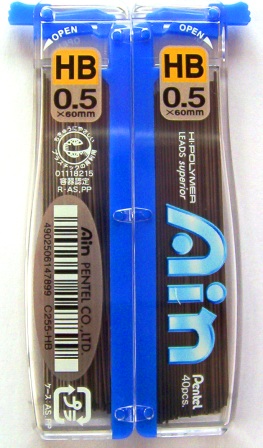


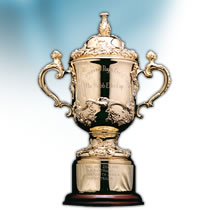
 At last, Cup Final day was here. Would Switzerland’s Caran d’Ache finish the day like David in his match with Goliath, or would Japan’s Pentel continue their seemingly inexorable march to victory? Many felt that the match was there for Pentel to lose, that whatever happened, Caran d’Ache would be heroes as they had already far exceeded all expectations, whilst anything other than victory for Pentel would be an ignominious disaster.


 Posts
Posts


