Uni Kuru Toga
OK, here’s a new one. Fresh out of the postie’s satchel, sent to me by my friend in Japan. I believe it’s a relatively new release on the Japanese market. It is the Uni “Kuru Toga” (M5-450 1P) mechanical pencil by Mitsubishi Pencil. What does Kuru Toga mean? Well, apparently ‘Kuru’ is a sort of Japanese sound symbolism that we don't really have in English, but anyway it's associated with ‘turning’, and ‘Toga’ is the shortened form of ‘togaru’ which means ‘be sharpened’. The pencil itself has 'Kuru Toga Engine' printed on it.
 Quite simply, the idea is that as you write the lead is auto-rotated around so that it maintains a sharp point and doesn’t get a chisel edge on it, leading to changing line thicknesses as you write or if you rotate the pencil in your hand. The pencil comes with a 12 page little cartoon style A6 size booklet explaining the virtues of Kuru Toga. Now I don’t read Japanese, so no idea what it actually says, but here it is reproduced in full, so I think we can all get the general idea. I scanned it lay flat, so six scans of A5 size.


 I haven’t pulled the mechanism apart but clearly the concept is that the lead-holding jaws are mounted on a toothed clutch. Each time you press down to write the clutch teeth engage and the sliding faces cause the lead to be rotated around a fraction.
 The trick then is the constant lifting and pressing back down as you write. The clutch is springing apart and back together, rotating each time. Now this is a 0.5mm pencil, so a chisel edge on the lead isn’t a huge deal, but still, it’s a heck of an idea. There is also a 0.3mm version. Now that would be a sharp point! Still, Uni extol the virtues of the constantly sharp point for neat precise writing, and a reduction in lead breakage.
Right then. Does it actually work?
Well… yes, it does. Whether you really care, well…that’s another matter.
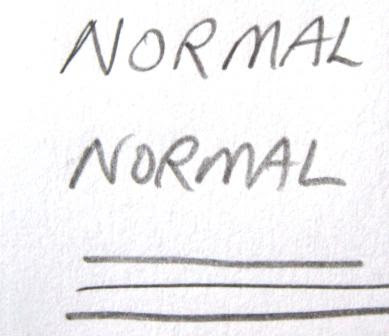
So, first thing I did was get an ordinary pencil (Lamy 2000) and the Kuru Toga and make sure they had good clean leads with a square end. Start writing. Clearly normal started out a thin line and got progressively thicker as the end wore down to a chisel point. I did not rotate the pencil in my hand. The picture below shows ‘normal’ at the start and then ‘normal’ after a line of writing. At the bottom of the picture are three lines – the middle one is at the start, the one above and below are after the chisel edge has been worn on the lead. So, we can see what happens normally, things get thicker as the lead wears. (Phew, it's like rocket-science)
 Now Kuru Toga. Below is a picture of ‘normal’ and ‘kuru’ after a couple of lines writing with each. Normal has worn to a chisel point and makes thicker lines. Kuru stays sharp.
 To recap – here’s the 3 line test for both, shown together. For each, the middle line is the start with a fresh new lead, the lines above and below are drawn after a couple of lines of writing with that lead.
 One thing I did note with Kuru Toga was that it always felt slightly scratchy on the paper. You know how when you pick up a pencil and by chance you start writing with the sharp side or tip of the chisel point and it digs or catches a little on the paper. Well, that’s basically what kuru is doing, always presenting the sharp edge to the paper, so it’s not the smoothest of writing experiences. Still, nothing to get too hung up over.
You know, to some extent it almost doesn’t matter how well this pencil works or not, it’s the thought that counts. These sorts of ideas and innovations are occurring in Japan, not elsewhere. Just look at that booklet! This is clearly the product of a design team and company that really think about their product and their market, see a future, try something new, move forward, and not just think, “Oh, it’s a pencil, we’ll always sell them, but there’s nothing much ever going to happen with pencils! They’re a cash-cow, just milk them.”
Link to the new Uni Kuru Toga High Grade


 “Koh-I-Noor, Made by L & C Hardtmuth In Austria” and on the other side “2B, British Graphite Drawing Pencil, Compressed Lead”. So, it’s British yet made in Austria? I wonder if they mean the graphite came from Britain?

 “Berol, EAGLE JEANS, USA, HB, 2”. The paint finish appears to be an attempt to imitate denim fabric, as in a pair of blue jeans.
 A square unpainted, unmarked, raw pencil.


 No photo because its gold on yellow and so doesn't really show up, but a Made in Bavaria Swan Manifold Ink Pencil.
 The first few letters of the marking have been sharpened off, but reconstructed it would apparently read, “Creta Laevis, E Wolff & Son, Inventors, London, (the colour)”. The colours I have are Green No 1, Green No 3, Olive Green, Sepia No 1 and Bn Pink. The web seems strangely silent on these Creta Laevis, but apparently they are a sort of pastel pencil. Anyone know anything interesting about them? Are they still made, etc?
 Note how the core does not go through to the end of these Creta Laevis pencils, unlike their graphite cousins to the right in the photo. I guess if the pastel core is expensive, it makes sense for it to stop a little short of the end so that none of the core is wasted when the pencil becomes too short.


 Woo-hoo! The Caran d’Ache
 So, the nice rosewood glass-topped presentation box contains a 2mm clutch pencil - the silver-plated rhodium coated, chevron pattern Ecridor Fixpencil.
 You also get an eraser, a set of coloured leads and an art booklet.
 The set of leads is one each of red, blue, green and yellow. Even better, they are actually aquarelles, or watercolour leads. So you use them like normal coloured leads, but also you can brush or wash them over with water to blend and create new colours. The little booklet tells you all about the various different techniques.

 It appears though that I have some way to go before my first exhibition.

 I also bought a set of ordinary graphite leads too.
 The eraser is rather impressive. Far too good looking to actually use, so no idea how well it really works.


 Posts


