Yoropen Pencil Review
Is it a…mechanical pencil?
Good question. Well, it’s a pencil so lets just put definitions to one side for the moment.
My Yoropen pencil certainly gathered more than its fair share of “What’s that?” type questions from my work colleagues whilst I was using it for this review. That strange shape really catches people’s eye. Yoropen’s are available in several different models and in ballpoint pen and pencil modes. My model is the Executive pencil - it’s fairly heavy in the hand, more than you might expect, and the balance is a bit top heavy.
The Yoropen Executive Pencil comes in a rather attractive and functional case, much like the small cases for compact reading glasses (not that I am familiar with those!) The case provides excellent protection for the pencil when it is not in use. The writing tip itself is protected by a screw on plastic cover. When the pencil is in use, the screw on cover can be screwed onto the top end of the body as an interesting looking extension.

Yoropen have won a bunch of design awards and claim three main benefits for their ergonomic design – finger support, visual space and adjustable grip. The offset Z tip design also allows the writing tip to be much more vertical to the paper whilst allowing the pencil to be held at a traditionally sloped angle.

The Yoropen pencil is what is frequently called a ‘push-point’ or ‘pop-a-point’ pencil. I remember that for a year or two back in my primary school days push-point pencils were all the rage because of their easy use as blow-guns or other types of weaponry. Just to explain this ‘push-point’ business, the lead is fixed in a small plastic casing which in turn is usually held inside a tube. When the lead has worn down you remove the whole casing and replace it with a new casing. That then leads to the question, “Are push-point pencils mechanical pencils?” It’s not really advancing the lead in anyway, it’s an entire replacement of the lead, so I tend to think they aren’t mechanical pencils…but have your say in the Poll in the sidebar. (The poll is now closed, results
here)
So, the Yoropen has a triangular rubber grip, as you might expect from an ergonomic type writing instrument. The rubber has a small amount of give under finger pressure and is a reasonably grippy compound so overall the grip section does work.
The grip is also twistable, so you can orientate it to suit. I imagine this might be of more use on the Yoropen pen (especially to left-handers) rather than the Yoropen Pencil. Twisting the grip takes a fair bit of effort so it is not something you would routinely change. The Z shape of the offset tip also creates a wide ‘end-stop’ for the grip which some folk may use as part of their grip.

But, and it’s a big but, that Z offset tip section and triangular grip means you cannot in any normal fashion rotate the pencil…so as your lead wears down you quickly get a chisel edge (or rather a square end since the lead is somewhat perpendicular to the paper) and you can’t rotate it…and because it’s a thick lead push-point pencil you quickly loose that fine tip and get into the thicker main body…you see where I’m heading. Basically Yoropen lays down graphite like an ordinary woodcase pencil or leadholder, but one that you cannot rotate to help keep a sharp point on. For me personally, I think the technical term is “Yurr??” That pretty much sums it up. In an effort to keep the lead sharp I often resorted to holding the Yoropen at some strange sideways angle or even ‘upside down’ when doing some lines or ticks, etc just to try and re-sharpen a bit of a point on the lead. The lead supplied in the push-points was fairly hard wearing - I would have guessed F or perhaps H grade although I believe Yoropen claim HB. In any event I think I got my moneys worth of letters out of each push-point…but it was fat lettering. “Uggg”.
Now for the bad stuff. The push-points have some small amount of wobble when seated on their holder spike. The offset tip is touted as improving vision so you can easily see what you are writing, but it makes it a little harder to intuitively position the lead precisely. So, combine that with lead wobble… some of you precision-obsessed readers out there will already be ramming your keyboard through the screen to try and blot out the horror. Oh, of course the lead is also rather noisy. I assume it’s a ceramic lead like in a woodcase pencil.
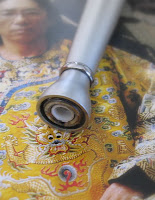
Only one push-point cartridge is held on the writing tip at a time, but more are stored in the main body – 9 to be exact, giving a total of 10 overall. You push your used cartridge into the top and a new one is pushed out of the other end which you then stick on the holder post. If you push your used one into the top end fairly forcefully the new one often shoots out the other end in a rather childishly pleasing manner.
In closing then, if you are convinced that there is a proper pencil-to-paper angle for general pencil writing purposes and that angle is relatively vertical, then the Yoropen achieves that angle. However you then find yourself in the worst of both worlds – you can’t sharpen and can’t rotate. Sure, you could replace the pop-a-points at a ridiculous rate and thus maintain a constant sharp lead, but that just seems wrong to me. Yes the Yoropen grip may well be useful for some folk with dexterity problems, and yes the offset Z tip may improve vision, but that’s at the expense of accuracy. Here I go then, flying in the face of prestigious international design awards and a truckload of user testimonials. I imagine my opinion of the Yoropen ballpoint pens might well be different, and some folk with special grip needs may find the Yoropen pencil to their liking, but for the vast majority of us the Yoropen pencil just doesn’t cut the mustard and would not be a good choice.
• Best Points – it will attract other peoples attention!
• Not So Good Points – read the review!
• Price Range – Mid/High.
• Does this pencil make it into the Top 5? - No.
Dimensions – Length 142mm excl tip cover, grip zone 14mm each side of the triangle. Balance point about 75mm up from the tip.


 Posts
Posts


