
I’ve recently had a bit of thing going for coloured leads, and blue leads in particular, so I thought it was time to do my bit for “art”? I have accumulated a fair few different blue leads and now its time to put them to the test, in the “Great Blue Challenge”.
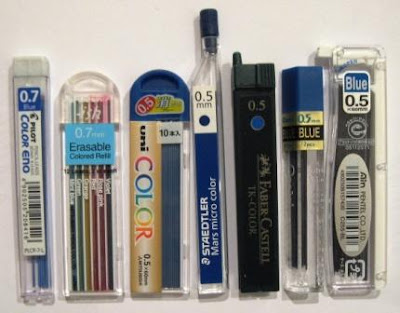
The contestants are, from
left to right:
Staedtler mars micro color – 0.5mm, blue
Pentel – 0.5mm blue.
Uni Color – 0.5mm blue. (Incorrectly labelled as 0.7 in the scans below)
Pilot Color Eno – 0.7mm blue.
Faber-Castell TK-Color – 0.5mm blue.

The Blues Brothers?
I feel it is my duty to uphold the Queen’s English and point out that, except for Pentel, every one of these foreigners have spelled “colour” incorrectly. Pentel have shown admirable judgement and avoided the word entirely!
So first thing I did was a bit of general scribbling and doodling with the leads. The Staedtler lead is very weak, and wore down very quickly. I had to make sure to only advance a minimum amount of lead out the tip, not press too hard and hold the pencil perpendicular or the breakages were just too many to bother with. On the plus side though, it does lay down a fairly good solid darkish blue line.
The Pentel lead is miles stronger than Staedtler and wears down much slower, but it lays down the lightest blue line of the 5 Blues Brothers.
The Uni lead is also strong and slow wearing. Its blue is a somewhat different hue to the others.
The Pilot lead is 0.7mm, quite strong as you would expect. It is also slow wearing. Seeing this is the only 0.7mm Blues Brother, I got out some Pentel and Uni –ish blue 0.7mm leads for a quick strength comparison. To my surprise, Pentel was the weakest, with Pilot and Uni being basically the same as each other.
For the Faber-Castell lead just read my comments for Staedtler again, although their blue is a fractionally lighter colour.
Next then a quick spot of erasing, using three test erasers – Staedtler Mars plastic (vinyl), Faber-Castell PVC-Free and Factis 36R (natural rubber). The results are rather similar for all three erasers, there’s no big difference to their performance, but if I had to choose a winner I’d say that the vinyl Mars plastic eraser was the best. There is though a big difference in the erasability of the different leads. The Uni is definitely the most erasable lead, erasing almost totally, similar to plain graphite lead. Next is Pentel and then the Pilot which both have good erasability but leave some residue behind. The Staedtler and Faber-Castell leads are considerably less erasable than the other leads, leaving a lot of blue behind, irrespective of which eraser used.

Overall then, Staedtler and Faber-Castell are very borderline, getting close to being unusable because of breakages and fast wear, and having poor erasability. Pentel, Pilot and Uni are clearly superior leads, with acceptable strength so it’s mostly just a choice of which shade of blue suits you. But one Blues Brother must be the leader of the gang – colour, strength and erasability, for these reasons I choose Uni.
Now then, another aspect of blue leads is their use as non-reproducible leads in graphic work. I wanted to check this out, so enlisted the help of Glen who has previously contributed a guest posting on non-reproducible leads. So, I’ll now hand over to Glen…
**********************
Hi folks, Glen here to throw in my two-cent's worth on a comparison of the non-reproduction suitability of a number of different brands of mechanical pencil leads. What, you may ask, is non-repro? Well be sure to peruse
this past post post haste to get up to speed on the nitty-gritty of the illustration uses of blue leads.
Are you back yet? Good... we can begin.
I started by scanning in a sampling of different blue leads kindly supplied by our host, and added two of my own. The Pilot Color Eno Soft Blue is the same lead as the Pilot Eno Blue provided by Dave, but, as the name implies, in a different hue. Much lighter and more turquoise.
Lighter is b.... well, I'm getting ahead of myself there. More on that later.
The Prismacolor / Sanford Verithin Non-Photo Blue is actually not a mechanical pencil lead at all, but a traditional pencil, and the standard to which I wanted to compare all others. If you want Non-Photo (the older name for non-repro) blue and like pencils - use this. But if, like me, you prefer mechanical pencils (and I think I'm safe in assuming such) then what comes closest? Read on fellow travellers and you shall see.....

This first image shows the varying hues and darknesses of the different blue leads scanned in full colour. In itself not important (unless you're using blue lead for colouring purposes) but as we proceed you'll notice a correlation between the hue of blue (wasn't that a late 60's Pscyhe band?) and it's suitability for non-reproduction use.
As well please note the black ink lines of varying thicknesses, strength and size. We'll use these as guides to the amount of blue remaining for each different type of lead.

Our second image was scanned in the "Grayscale" mode. Grayscale scanning gives inked images a softer feel, with not only pure black and white reproduction, but shades of gray as well. I chose a medium setting for this test, with, as you can see, a wide range of results.
The Prismacolor Non-Photo pencil has disappeared completely, as has the Pilot Color Eno Soft Blue. But all others show at least some pencil marks under their ink lines.
The Pentel didn't fare too badly with the Uni following closely behind.
Should you choose either of these leads it's probable that some adjusting of the Histogram / Levels / Brightness - Contrast controls on your scanner or in Photoshop (or whatever other program you use for image manipulation) would be able to remove most, if not all, of the remaining pencil.
I'm afraid though, that the remaining leads I'd have to deem unsuitable for non-repro use in grayscale scanning. The Pilot Eno Blue (regular) and especially the Faber-Castell and Staedtler just aren't cut out for these parameters.
We shall move on....

The third image was scanned in Bitmap or Black & White mode. This method scans the image as either a black or white pixel, with no grey in between. Bitmap scanning works well when you want a crisp black line, suitable for paint bucket filling, and allows for a nice white background. Be aware that Bitmap images require higher resolution scans to achieve smooth lines though. Low resolution will show "staircasing"
or jagged edges.
Enough from Professor Flatbed and on to the test!
As you can clearly see Bitmap scanning is more forgiving to the blue leads, with three (The Prismacolor, Pilot Soft Blue and Pilot Eno) passing with flying colours (or should that be "flying black & white"!). Even the Pentel and Uni look good with only the slightest hint of pencil. The Faber-Castell and Staedtler are once again in the rear and apparently unsuitable in our task. Some adjustment of the Threshold level on your scanner is possible to help remove the remaining pencil, but there's not much leeway.
So in conclusion I'll state my laboriously exacting findings using this highly advanced mathematical equation...
Light Blue Lead = Good, Dark Blue Lead = Bad.
Or put another way, and not taking into account pricing, softness / break-ability, erase-ability or lead size, I'd recommend the Pilot Color Eno Soft Blue, with the Pentel next and Uni third. I'm afraid the Faber-Castell and Staedtler just don't cut the mustard when it comes to Non-Repro use.
I hope this helps if you were thinking of trying, switching to or experimenting with blue pencil leads. Give it a whirl - I don't use it for every job, but it sure comes in handy when you need it.
Over and out - Glen Mullaly
*************************************
Right, it’s Dave back again. After Glen and I prepared all the above, we noted that some of it was inconsistent with Glen’s comments to his
original posting, namely the scanning properties and erasability of Pentel vs Staedtler. Clearly a little more investigation was required.
It appears that heavy or light pressure when using the blue lead is an important factor. For scanning, Glen did some re-testing and is sure that when applied with light hand pressure, the scanning results are reversed to our heavy handed results above, namely with a light hand, Staedtler is better for scanning than Pentel.
We both also did some more erasing tests. Glen felt at light pencil pressure the Pilot Eno Soft Blue erased completely, the Staedtler mostly, and the Pentel poorly. At heavy pencil pressure the Pilot Soft Blue still erased well, but the Pentel and Staedtler switched places with the Pentel faring slightly better, but both the Pentel and Staedtler erased poorly, the Staedtler almost not at all. Personally I felt that at light pencil pressure the erasability of Pentel and Staedtler were similar, but markedly improved upon their heavy pressure performance. One thing I did notice though, at light hand pressure the Staedtler lead felt miles better than Pentel. Smooth soft even Staedtler line versus hard scratchy variable Pentel line. Very surprising to a Pentel fan like me.
Anyway, I guess what this all boils down to is that if you are using coloured leads you really do need to try a few out and experiment to find the best mix of paper type, hand pressure, lead brand and colour to give you the performance that you want.
(This might just be the longest posting to date!)
Follow Up Article -
Lightfastness or Fade Testing of Blue Leads
 Jiahe then challenged me to do some fade testing (or light fast testing) on the various blue leads that I had, and I reluctantly accepted.
 I scribble-coloured a rectangle of about 5cm long and 1cm wide for each lead, and then cut the paper into three long strips so that they could be stored separately but re-assembled back together. The strips were labelled “sun”, “some” and “dark”, and were exposed as below:
 Yarrrrr???!!! Where has Pilot Color Eno gone? The “sun” exposure has completely faded and disappeared. At first I did a double take – did I forget to colour in that part? Had I aligned my three test-strips of paper incorrectly? If you look really hard you can see some remnants, but for all intents and purposes Color Eno has completely gone. The “some” exposure has had a little fading, though not much.
 Well the sun has done for Uni Color and it’s a goneburger. The “some” exposures for Pilot Color Eno and Uni Color are clearly starting to fade. Note that unlike Uni Color, Uni ~ish Mint Blue is holding up fairly well although the “sun” exposure is starting to show some fading. All the others are looking good.
 Basically more of the same. The “some” exposure for Pilot Color Eno appears to be on its last legs.
 Four of our blue leads showed little to no fading and have completed the lightfastness test with flying colours. Full marks to Staedtler Mars Micro Color, Faber-Castell TK Color, Pentel PPB and Pentel Ain. Fifth out of seven is Uni ~ish Mint Blue which has shown some fading for the ‘sun’ exposure, and a little fading for the ‘some’ exposure. Bringing up the rear, and a long way behind, are Uni Color and Pilot Color Eno. Pilot Color Eno 'sun' disappeared in week 1. Perhaps you artists out there can tell me of some use for special disappearing blue leads. Secret agents?
 Woo-hoo! The Caran d’Ache
  So, the nice rosewood glass-topped presentation box contains a 2mm clutch pencil - the silver-plated rhodium coated, chevron pattern Ecridor Fixpencil.
  You also get an eraser, a set of coloured leads and an art booklet.
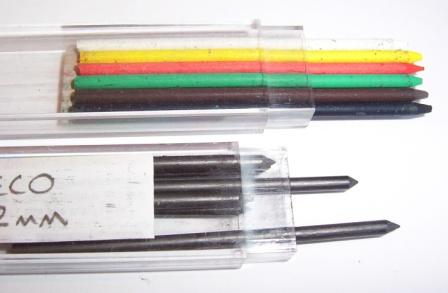
 The set of leads is one each of red, blue, green and yellow. Even better, they are actually aquarelles, or watercolour leads. So you use them like normal coloured leads, but also you can brush or wash them over with water to blend and create new colours. The little booklet tells you all about the various different techniques.
 It appears though that I have some way to go before my first exhibition.
 I also bought a set of ordinary graphite leads too.
  The eraser is rather impressive. Far too good looking to actually use, so no idea how well it really works.
 3. Scan in, use Photoshop to convert image to shade of non-repro blue (about 75% Cyan) and print out on inking paper. Depending on the job and the print size of the work I may do this in sections.
 4. If my initial sketch was fairly tight I may go directly to inking (going over the blue lines with black ink) or if not I'll finish the sketch using my non-repro blue mechanical pencil (you knew I had to get to this eventually!!!) and then to inks.
 5. Scan in image as either a bitmapped image (preferred) or grayscale. Then in Photoshop, after converting to grayscale (if necessary), by either adjusting the levels or using the channels I remove any traces of the lines left by the blue - and then I'm good to go. Whew!
 6. Colour and finish.
 As I said this is just how I approach some of my jobs, every illustrator will have their own preference.


 On the down side though, there are some issues with strength. I certainly had some breakage problems, red in particular seemed to be a bit prone to breaking. Strangely though, the break often occurred up inside the pencil, rather than snapping off down at the tip. Another problem was that the lead tended to crumble under pressure. When you press down hard, particularly as you first start writing, a few little specks crumble off and so you get the equivalent of graphite dust left floating around on your page. I found the blues to be a bit worse than the other colours for this crumbling.




 Posts
Posts


