Thursday, June 09, 2011
Freds Pencils
Just FYI, you might want to visit this newish blog, Freds Pencils. It's primarily wooden , but mechanicals get a look in too.

Tuesday, June 07, 2011
Giveaway Feedback 3
Palimpsest was the winning girl in the 5th Birthday Giveaway 1, and she has kindly sent in a few words and pictures of her winnings. So, over to Palimpsest.

How wonderful to get a parcel in the post – and with a handwritten letter too. Many thanks to Dave’s Mechanical Pencils. The pencil within is the Tasche SP-10T Ohto Japan. A mini mechanical pencil just over 100mm long but post the cap and it becomes a full-sized writing instrument. Cap and barrel are made of aluminium – lower part of the barrel is silver, the other half and the cap is a smoky pink. The tip, trim and clip are chrome. Unscrew the top and a mini eraser is revealed.

Performance? The Tasche SP-10T Ohto is a smooth writer producing a nice dark line. There is one disadvantage. The top of the barrel is a wobbly affair. By pressing it down a fresh pencil tip is revealed. When it doesn’t serve that purpose it rotates freely to the annoyance of this user. When the cap is posted the barrel is inadvertently pressed down to produce more pencil lead. This can be prevented by holding on to the chrome ring rather than the barrel when posting.


Eraser is so tiny that it must be used in emergencies only. But then trembling hands can hardly cope with the fiddly task of unscrewing the top. And it takes more than 5 seconds to complete the task.
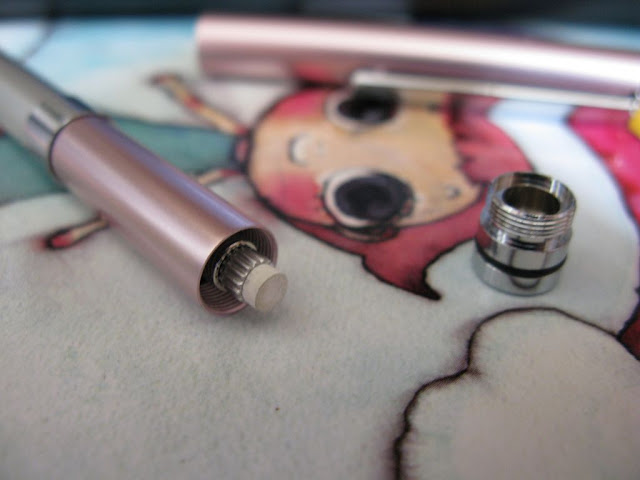
Still, the mini Tasche is a winner for portability and smooth writing. And as all mechanical pencils it promises to go where no pencil sharpener can follow.
Thanks Palimpsest.
Just FYI, for anyone interested, here's my review of the Ohto Tasche mechanical pencil.

How wonderful to get a parcel in the post – and with a handwritten letter too. Many thanks to Dave’s Mechanical Pencils. The pencil within is the Tasche SP-10T Ohto Japan. A mini mechanical pencil just over 100mm long but post the cap and it becomes a full-sized writing instrument. Cap and barrel are made of aluminium – lower part of the barrel is silver, the other half and the cap is a smoky pink. The tip, trim and clip are chrome. Unscrew the top and a mini eraser is revealed.

Performance? The Tasche SP-10T Ohto is a smooth writer producing a nice dark line. There is one disadvantage. The top of the barrel is a wobbly affair. By pressing it down a fresh pencil tip is revealed. When it doesn’t serve that purpose it rotates freely to the annoyance of this user. When the cap is posted the barrel is inadvertently pressed down to produce more pencil lead. This can be prevented by holding on to the chrome ring rather than the barrel when posting.


Eraser is so tiny that it must be used in emergencies only. But then trembling hands can hardly cope with the fiddly task of unscrewing the top. And it takes more than 5 seconds to complete the task.

Still, the mini Tasche is a winner for portability and smooth writing. And as all mechanical pencils it promises to go where no pencil sharpener can follow.
Thanks Palimpsest.
Just FYI, for anyone interested, here's my review of the Ohto Tasche mechanical pencil.
Saturday, June 04, 2011
For The Ears
The ears have been neglected on this blog, but AndrewJ from Australia has put that right. Long time readers may recall his guest review of the Pentel Forte mechanical pencils. Well he recently alerted me to a podcast from the BBC that is all about two pencil companies from the same city in Germany. Have a listen.
BBC Worldbiz podcasts are here.
The specific one in question, "GlobalBiz:Quick on the Draw: 14 May 11"
Thanks Andrew.
BBC Worldbiz podcasts are here.
The specific one in question, "GlobalBiz:Quick on the Draw: 14 May 11"
Thanks Andrew.
Tuesday, May 31, 2011
Chatelaine and Vintage Mechanical Pencils
Last year a self-confessed stationery addict who reads this blog contacted me and corresponded a little about her eclectic collection of mechanical pencils. With a little encouragement, Sandra agreed to do a guest piece on some of her pencils, so here’s her article on some pencils that came from her great aunt.
The Inheritance
My interest in Victorian and Edwardian mechanical pencils and pens began when I inherited the ones in the picture below from my Great Aunt. She was born in 1899 but her parents, to whom most of the pencils had belonged, were born in the 1870’s. These pencils and pens might not be as convenient to use as modern mechanical pencils but I thought they were beautiful and I felt lucky to have them. As a child I liked to listen to family stories - to hold an object in my hand which some of these elderly people had owned and used when they were young somehow made these people’s lives more real to me and linked me back through generations of my family in a way nothing else could.
I am not a technical person and how these things were made was less interesting to me than their ability to evoke aspects of everyday life in the late 19th and early 20th centuries. Pens and pencils were things used constantly by thousands of people in 1900. But many of these late Victorians and Edwardians would have understood that their grandparents might only have dreamed of the education and literacy which would make carrying a pencil with you a normal thing to do.
The design of many of these old pencils reflects not only the tastes of a different era but also links through to the way people dressed and the way they conducted their lives. For example, this was an age when no man would consider himself properly dressed without a jacket and a waistcoat – and the ring on the end of some pencils could have been used to attach the pencil to the watch chain which adorned almost every waistcoat. There, it rested safely in perhaps the opposite pocket to your watch, if you wore a double Albert, or even in the same pocket - ready to hand when you needed it.
Women’s clothes in the 19th century had far more pockets in them than they do now – the watch and chain was not exclusively a male adornment, as this picture shows.
Women too were still wearing chatelaines (see footnote). By the end of the 19th century these were more a fashion item than a way to keep your personal belongings safely on your person. But they frequently included a pencil and/or pen and tiny note cards amongst their contents

In an age when there was no telephone, but when a postcard dispatched before 9am from your writing desk in the library or morning room would be delivered to someone in the same town before noon; when sending written messages was as normal and as frequent as sending text messages is now, a pencil or pen was a very useful thing to have about your person.
As far as I am concerned – it still is!
Two of my pencils are examples of one-ended combinations. That is, they contain both a pen and a pencil.

To use the bottom pencil, you twist the lower half of the barrel to make the pencil nozzle emerge from the centre of the barrel. Leads are fed in through the nozzle end of the pencil. The small cap at the other end of the barrel unscrews to give you a space in which to keep spare leads. You can retract the pencil and then use the sliding collar to push up a nib holder for a steel dip-pen nib. This comes out of a slot in a collar which encircles the business-end of the writing instrument.

I think this is gold-plated as it has no hall marks on it and it is showing small areas of wear – but it doesn’t seem to need polishing!
The other example in the picture also includes both a pen and a pencil. It has a slider pin in each side of the inside, plain barrel – one to push out the pen and the other to push out the pencil. In this case the pencil comes out towards one edge of the barrel opening and the pen towards the opposite edge. This example as well as allowing you to slide both writing instruments down inside the plain part of the barrel, then allows you to slide this whole assemble inside the ribbed end of the barrel. (As in the first picture). The ring at the end allows you to hang it from your watch chain from or from your chatelaine. It’s a white metal, but not silver.
This type of design with pen and pencil at the same end was popular right into the 20th century and I suspect the gold-coloured one is later than the other one.
The pencil below, however, I think is probably a late Victorian one, largely because of the heavy chased decoration and the weight of it.

The knurled collar at the base of the nozzle of this pencil should make the lead advance – but at this point in time it doesn’t work. The sliding collar on the barrel retracts the end of the pencil. So ‘pocket-safe’ is not exactly a new idea. Electronics apart almost everything you think is a modern idea – the Victorians probably got there first!

There is no hallmark on the pencil but it looks and feels like silver and it tarnishes slightly if left for any length of time. I suspect that this pencil has been well-used at one time as the whole pencil has a slight curve along its length.

It has a bloodstone in the seal end. (Which just happens to be my birth-stone.)
This is a small pencil with a spherical finial.
 The whole of the nozzle end, beyond the part of the barrel with parallel sides, twists to advances the lead which is quite thick and is fed in from the writing end. It is only 6cm (2.5 inches long) and the thin covering of white metal has worn through in some places to what looks like a brass inner sleeve. A handy thing perhaps to keep with a notebook in your desk, or in a writing case, or it may even have belonged in an etui.
This slim gold pencil is, I think, newer.
 Although it looks in this picture as if plate is wearing off this is just reflections from my rotten photography! The engraving on the barrel, beneath a picture of a Pointer dog, reads “Baker’s Pointer Pencil Pat 7985110, 9ct.” The finial unscrews to reveal a space for keeping spare leads. These are quite thick both in comparison to modern pencil leads and considering the slim shape of this pencil. Leads are inserted from the writing end and advanced by twisting the top half of the barrel (from the double ring to the right of the engraving.)
Although these are my most treasured pencils - because they are family things - they are not of course the only ones. Either you have the collecting gene or you don’t – and I can’t even imagine what it’s like not to have it! I’m not the sort of person who has to have every example of something, but if its interesting or unusual or appealing, in short if it tells me very plainly ‘Take me home’, then who am I to argue?
Footnote
The simplest explanation of the chatelaine I have found is from 'The History of Needlework Tools and Accessories' by Sylvia Groves:
“In Anglo-Saxon England women carried their needlework implements in cylindrical metal boxes, about 3 inches in height and 2 inches in diameter, suspended from the girdle. . . In the domestic life of the period, and for many centuries to come, there was little provision for the safe storage of personal belongings: privacy as we understand it was quite unknown. Small, individual possessions were therefore, of necessity carried on the person. Not only sewing implements but keys, pomander, seal, pen-knife, swung from the waist on chains or cords.
These accessories lent themselves naturally to enrichment and decoration and came eventually to be regarded as symbols of occupation and rank. In a large house or castle, for instance, it became the prerogative of the mistress or chatelaine to wear an elaborate equipage of this kind, and in the course of time the name chatelaine passed from the wearer to the object itself.”
The Inheritance
My interest in Victorian and Edwardian mechanical pencils and pens began when I inherited the ones in the picture below from my Great Aunt. She was born in 1899 but her parents, to whom most of the pencils had belonged, were born in the 1870’s. These pencils and pens might not be as convenient to use as modern mechanical pencils but I thought they were beautiful and I felt lucky to have them. As a child I liked to listen to family stories - to hold an object in my hand which some of these elderly people had owned and used when they were young somehow made these people’s lives more real to me and linked me back through generations of my family in a way nothing else could.
 |
| The inherited pencils – with standard wooden pencil for size comparison. |
The design of many of these old pencils reflects not only the tastes of a different era but also links through to the way people dressed and the way they conducted their lives. For example, this was an age when no man would consider himself properly dressed without a jacket and a waistcoat – and the ring on the end of some pencils could have been used to attach the pencil to the watch chain which adorned almost every waistcoat. There, it rested safely in perhaps the opposite pocket to your watch, if you wore a double Albert, or even in the same pocket - ready to hand when you needed it.
Women’s clothes in the 19th century had far more pockets in them than they do now – the watch and chain was not exclusively a male adornment, as this picture shows.
 |
| A wedding picture taken in 1877, earlier than the date of my pencils but giving an idea of how some watch chains were worn -from a button hole to a waistcoat pocket or in the woman’s case a pocket made at the waist of her dress. Picture from Avril Lansdell, Wedding Fashions 1860-1980, copyright Miss P Williams |

 |
| The Countess of Aberdeen, 1891 (copyright National Portrait Gallery) from Vanda Foster, ‘A visual history of costume:the 19th century.’ by Vanda Foster. |
As far as I am concerned – it still is!
Two of my pencils are examples of one-ended combinations. That is, they contain both a pen and a pencil.
To use the bottom pencil, you twist the lower half of the barrel to make the pencil nozzle emerge from the centre of the barrel. Leads are fed in through the nozzle end of the pencil. The small cap at the other end of the barrel unscrews to give you a space in which to keep spare leads. You can retract the pencil and then use the sliding collar to push up a nib holder for a steel dip-pen nib. This comes out of a slot in a collar which encircles the business-end of the writing instrument.
I think this is gold-plated as it has no hall marks on it and it is showing small areas of wear – but it doesn’t seem to need polishing!
The other example in the picture also includes both a pen and a pencil. It has a slider pin in each side of the inside, plain barrel – one to push out the pen and the other to push out the pencil. In this case the pencil comes out towards one edge of the barrel opening and the pen towards the opposite edge. This example as well as allowing you to slide both writing instruments down inside the plain part of the barrel, then allows you to slide this whole assemble inside the ribbed end of the barrel. (As in the first picture). The ring at the end allows you to hang it from your watch chain from or from your chatelaine. It’s a white metal, but not silver.
 |
| Both pens with pencil showing. |
 |
| Both pencils with nib showing. |
The pencil below, however, I think is probably a late Victorian one, largely because of the heavy chased decoration and the weight of it.
The knurled collar at the base of the nozzle of this pencil should make the lead advance – but at this point in time it doesn’t work. The sliding collar on the barrel retracts the end of the pencil. So ‘pocket-safe’ is not exactly a new idea. Electronics apart almost everything you think is a modern idea – the Victorians probably got there first!
There is no hallmark on the pencil but it looks and feels like silver and it tarnishes slightly if left for any length of time. I suspect that this pencil has been well-used at one time as the whole pencil has a slight curve along its length.
It has a bloodstone in the seal end. (Which just happens to be my birth-stone.)
This is a small pencil with a spherical finial.
This slim gold pencil is, I think, newer.
Although these are my most treasured pencils - because they are family things - they are not of course the only ones. Either you have the collecting gene or you don’t – and I can’t even imagine what it’s like not to have it! I’m not the sort of person who has to have every example of something, but if its interesting or unusual or appealing, in short if it tells me very plainly ‘Take me home’, then who am I to argue?
Footnote
The simplest explanation of the chatelaine I have found is from 'The History of Needlework Tools and Accessories' by Sylvia Groves:
“In Anglo-Saxon England women carried their needlework implements in cylindrical metal boxes, about 3 inches in height and 2 inches in diameter, suspended from the girdle. . . In the domestic life of the period, and for many centuries to come, there was little provision for the safe storage of personal belongings: privacy as we understand it was quite unknown. Small, individual possessions were therefore, of necessity carried on the person. Not only sewing implements but keys, pomander, seal, pen-knife, swung from the waist on chains or cords.
These accessories lent themselves naturally to enrichment and decoration and came eventually to be regarded as symbols of occupation and rank. In a large house or castle, for instance, it became the prerogative of the mistress or chatelaine to wear an elaborate equipage of this kind, and in the course of time the name chatelaine passed from the wearer to the object itself.”
Tuesday, May 24, 2011
Schneider iD Mechanical Pencil Review
Schneider iD Mechanical Pencil Review
In recent times Keir from Scotland has slung his bagpipes over his shoulder, hitched up his kilt and gone exploring through the bazaars of the United Arab Emirates, and it is fair to say he has found many bargains to haggle over with the mechanical pencil merchants of Dubai and Abu Dhabi. Keir has been feeding his strange and growing Rotring obsession, finding such delights as brand new dusty old Rotring 900’s still sitting on shelves…neglected…just waiting for a pencil person to recognise and rescue them. Keir took pity on poor me, far from the bazaars and sent a package of goodies my way. Amongst the exotic contents of the package was a strange looking little pencil which immediately caught my eye…the Schneider iD mechanical pencil... that short, sharp, tapering yet fat body, the very antithesis of many a long sleek drafting instrument. Vast expanse of shiny chrome on matt black rubber body, fluorescent end cap, this pencil is making a statement and it certainly looks interesting, sitting on a desk.
Right time to pick up the iD. As expected it is rather weighty, 32 grams according to my kitchen scales. The body tapers so you can hold it fairly low down or high up as suits you, and it also has a large scallop taken out of it as part of the ergonomic design.

I’ve got to say the body scallop and general size of the iD just didn’t suit me for long term writing. The scallop just didn’t seem to be of any particular use or relevance to me. The thickness of the body meant I wanted to try and grip the iD fairly low down and the body scallop contour appeared to be too high up for me. Even gripping the body low down it was basically still too wide for me, long term.

However, having said that it didn’t suit me for long term writing, I feel completely the opposite when it comes to short term use – like writing a shopping list, writing down a phone number, a couple of quick notes during a telephone conversation, jotting the notes for this review in my notebook and so forth. As a pencil to have lying around to grab for short term use, the iD is well worth consideration, a definite competitor to the Lamy Scribble. Whilst I generally prefer thinner leads, the 0.9mm of the iD is acceptable for quick notes and doodles.
Take a look at that pocket clip. It is chrome plated steel, surprisingly springy and very unusually shaped. On the one hand it works quite well, but because the clip is so wide and wraps around the body it needs to bend whatever it is clipped to. So, it’s not so good on thick papers, etc.

Note the lanyard eye at the top of the pocket clip. A rather rare thing these days.

Neither the pocket clip nor the body scallop effectively stops the pencil from rolling on your desk, although they do try and partially succeed.
The lead advance mechanism is a twist top ratchet. The coloured end cap twists about ¼ turn to advance the lead. Naturally it springs back of its own accord. Ten activations will get you about 5mm of the 0.9mm lead. Although it is possible to do it one-handed, advancing the lead on this mechanical pencil is really a two handed job and thus a definite interruption to the writing process.
The lead sleeve is a short tapering cone and retractable for pocket safety.
Refilling the leads is a little unusual too. I certainly expected that big end cap to pull off, but it doesn’t. To refill the lead magazine you unscrew the tip section from the main body and pull the whole mechanism out.

Of course since the end cap doesn’t come off, there is no eraser beneath it, or anywhere else for that matter.
Markings on the mechanical pencil are “iD” printed on the body near the tip of the pocket clip, and “Schneider Germany” is moulded into the black rubber body at the top of the body. Now, the use of the word “Germany” does not necessarily mean ‘Made in Germany’, which I find rather misleading at times but there's no subterfuge or hidden origin here as the Schneider iD webpage states “Writing comfort and quality ‘Made in Germany’ ”.

Overall then, the Schneider iD as a very interesting mechanical pencil, and I’m very grateful to Keir for sending it my way. Thanks buddy.
• Best Points – The looks.
• Not So Good Points – personally the body is too wide for prolonged use.
• Price Range – Low/Mid.
• Does this pencil make it into the Top 5? - No.
Dimensions – Length 123mm, diameter 21mm at widest point. Balance point about 60mm up from the tip.
Tuesday, May 17, 2011
Wallpaper
Do you need to do some decorating? Fear not, Wes Z has come to your aid with some wallpaper.
It's his Pilot H-325 and the image is 1600 x 1200 pixels. Hopefully if you click on the image you will get a full size high resolution copy that you should then be able to download, save and use as your screen background.
Thanks Wes.
 |
| Image copyright Wes Z, used and made available for copying with his permission. |
Thanks Wes.
Subscribe to:
Posts (Atom)


 Posts
Posts


