Down here in my part of the world, Autopoint mechanical pencils are something of a rarity, and I don’t know an awful lot about them. A bit of web-surfing over the last few years gives me the impression that they were a major manufacturer in the USA during the middle part of last century, but like many such companies they later fell on hard times. They are sort of still going in one form or another, but seemingly as a mere shadow of their former glory. They have a basic website that offers sales to the public, but they never process my sales orders or answer enquiries. A few online retailers offer some of their products but they are often out of stock, so I don’t really know what’s going on.

One of my recent acquisitions from a bout of eBay madness is a 1948 catalogue from Autopoint. I’ve got a bit of an interest in general history and I like these old catalogues, magazines and so on as they are a glimpse back into the past. I like to compare them to today and think how things have evolved, and I get to pursue two interests at the same time – history and pencils. I bought my 1948 catalogue from a seller in Australia, and it came with a letter from Autopoint to an Australian company that was enquiring about their products. This is the text of the letter:
Letter from Autopoint, USA to Ronaldson-Tippett, Australia.
October 5, 1948.
Messrs. Ronaldson-Tippett
Attention: Mr. G. C. Netherway, Advertising Manager
Dear Sirs:
Although we have not been able to sell our products in Australia for some years, we do appreciate an occasional expression of interest such as yours to let us know there is still a potential demand for our products.
A copy of our Catalog No. 48A which illustrates our complete 1948 line of business gift items, including our pencils and ‘phone index, is going forward to you under separate cover and we are also sending, as a “Sample of No Commercial Value” one of our No. 6 pencils.
The price of such a pencil, with one line of “imprinting” is US$0.30. The second line, and each additional line, is $0.02½ extra. The printed ferrule below the eraser is also extra and priced as shown on page 15 of our catalog. Ordinarily this ferrule is of the same material as the clip and tip.
Unfortunately, we are not able to take payment in funds other than United States dollars. We have, however, been able to make some shipments to Jamaica, Trinidad, and other Empire points where our products are not normally prohibited if payment is made by some U.S. firm and no dollar exchange is involved in the shipment. This, of course, is a matter that is usually handled between the overseas consignee and their principals in this country and we are not involved in the financial end of the transaction.
Should you be able to enter a quantity of our pencils or other products into Australia, we will be glad to hear from you and give any order our best attention. In the event this is not possible at this time, we hope you will retain our Catalog for your future reference.
Thanking you for your letter and interest, we are,
Very truly yours,
AUTOPOINT COMPANY
J.H. Bosse
Asst. Export Manager
So where does this letter lead me….
Well firstly Ronaldson-Tippett, of Ballarat, Victoria, Australia were manufacturers of tractors, engines, power plant, and other heavy equipment for the agricultural and mining industry. I assume they wanted Autopoint pencils and business items as possible promotional giveaways, rather than as part of the launch of an office supplies company.
Secondly there is the reference to “the
(British) Empire”. Well that’s not really the right terminology. A case of old habits die hard, as the British Empire had ceased decades before. In 1948 the correct reference should have been ‘British Commonwealth’, but Empire was still used a bit. Back in 1948 I don’t think a New Zealander would mind being incorrectly referred to as part of “the Empire” but I’m not entirely sure about how an Australian would have felt, as they were generally far more distant from the ‘mother country’ than NZ was. Much of even the relatively recent history and personal identity of New Zealand, Australia, and some other Commonwealth countries is so intermingled with that of the United Kingdom its often hard to define when they became separate, perhaps particularly so for New Zealand as arguably the last major colony to ‘emotionally’ separate itself from the UK. Hopefully the reference to ‘Empire’ by a foreigner would have been seen in a flattering light and appeased Australian umbrage at the concept they weren’t independent people but were somehow subjugated by or part of an empire.
Thirdly in the paragraph on dealings with “the Empire” there is the reference to prohibited items and schemes to get around export/import problems. At the end of World War Two, the economy of Great Britain was in a terrible state. Years of wartime production priorities and enemy bombing had left many sectors of the economy badly damaged, and it took decades to recover. Some might say Britain never fully recovered. Food rationing didn’t end until 1954, some 9 years after the war ended. On the other hand, much like the USA, Australia and New Zealand emerged from the war with their economic base in good shape. In fact by the early 1950’s New Zealand’s per capita GDP was the second highest in the world…ahh, the good old days, before our long slide into mediocrity. The Australian economy was also doing very well back then too.
However all this prosperity masked many structural inefficiencies in the economy. Australia and New Zealand had very restricted protected economies, as alluded to in Autopoints letter. In the mid-1980’s New Zealand went through massive economic reform, transforming from a very restricted economy into a very open one. Back in the 80’s I recall an elderly colleague telling us youngsters how easy we had things these days. I’m talking from a New Zealand perspective here, but I believe things were equally restricted and crazy in Australia. Firstly there were quota restrictions on many items, so there might well have been a limit on the value of mechanical pencils able to be imported into New Zealand (or Australia), and only the quota holder was allowed to do the importation, although they could effectively on-sell the quota to another party. There were tender rounds where you bid to buy the quota the government was offering to sell. So for example the government might have set an annual import quota of “pens and other writing instruments excluding wooden pencils” at say $100,000 worth of imports. Companies then bid for the quota (in $10,000 parcels), allowing them to import writing instruments to the value of the quota they owned. So the winner might pay the government $500 to get quota allowing them to import $10,000 worth of writing instruments. It was effectively an auction so others may have paid more or less for the quota they won.
Quota was one thing, but foreign currency restrictions were another. Trading within the Pound currency block was somewhat easier than with real foreigners like the Autopoint Company of Chicago that used funny-money like the US Dollar. Back in the 80’s I was vaguely aware that not all that long before there were still schemes like Autopoint mentioned to get around foreign currency restrictions. Schemes like getting your associated company in another country to buy something and ship it to you, and you paid by shipping them something in return, or they deducted the amount from what they owed you, so you never actually sent any money out of the country. Shades of a barter economy. My colleague explained to us youngsters how back in the 60’s if our company wanted to buy a new imported industrial sewing machine for our clothing factory it was terribly difficult to get one, with things like quota restrictions, import licences, duties, taxes, and currency control all making life difficult. Things were apparently a little easier if it was a replacement for a worn out machine. In those cases a Customs Officer would come out with the new machine and witness the physical destruction (by gas-axe, hammer, etc) of the old machine and thereby somehow approve something that made it all easier. What a drama! I think my colleague was right, so much easier these days without any import quota or currency restrictions.
Whoa, all this rambling and I haven’t even opened up the Autopoint catalogue yet! Have to save that for a future post, with less rambling and more true pencil content.

 Actually they call it a document clip, a reference to how you can clip it to a thick sheaf of papers. It is a powerful spring loaded clip that will grasp about 15 sheets. Pentel advertise this pencil in their drafting section rather than general section. To me the document clip implies a general office or writing type pencil, but the name, the look and the features are very draughting or graphic art orientated, so perhaps they are aiming for a sort of cross-over pencil; general office and technical work?
 This is a vanishing point type pencil, with a push top ratchet lead advance mechanism. Similar to a ballpoint pen, pushing the top button first pushes out the tip section with its 4mm lead sleeve. Further operation of the top button
 advances the lead like a normal push top ratchet pencil. The mechanism only advances a very short length of lead each time. Once out, the sleeve is a fixed sleeve, but operating the document clip automatically retracts the tip section for pocket safety and to stop the sleeve getting bent as it’s carried around. It’s a very serious ‘wham slam’ spring loaded retraction system! Actually I wasn’t totally happy with this vanishing point mechanism. There is a very slight amount of movement in it, and particularly when you first start to write I felt like it was catching on the paper with the first tiny little wobble. Also with the tip extended, the grip is a fair way back along the pencil so it might not suit those who like to hold their pencil right down close to the tip.
 There is a small eraser under the top button. I suppose it’s better than nothing, but not that much. Occasional use only! There is a lead hardness degree indicator just at the top of the grip section. You can select to display 2B through to 2H. You have to unscrew the very front of the tip section just a little, which loosens the grip section so you can rotate it around to show the desired hardness grade in the window.
 Printed in black on the body is “GRAPHGEAR 1000 Pentel PG1015 Japan 6C .5” so you get the full story! Overall I would say this mechanical pencil is built to last, to give you many years of solid reliable performance, but I’m not sure I would recommend it as a general writing pencil. I think it’s more suited to being a technical pencil that also does a bit of general office work.


 When you hold the Ohto APS-280E in your hand it really feels like a wooden pencil.


 At first glance the EFAmatic looks like a wooden pencil, but then you quickly pick up on the fact that it’s actually plastic.


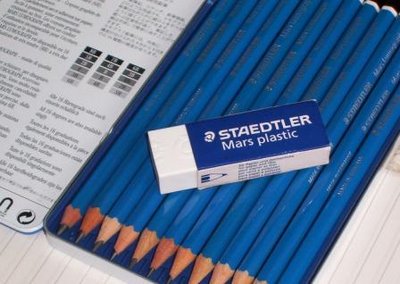
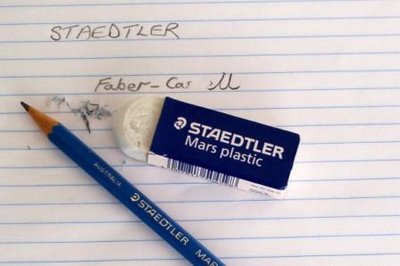 It is a reasonably large eraser which has some good and bad points. On the good side, you can get a firm grip on it which makes things easy if you have a lot of erasing to do, and you can erase an awful lot before you will need to buy a new one. So there’s slightly less need to panic during your exam when you suddenly realise you have to rub out half your wonderful design. On the bad side, whilst it starts out with nice square edges and a square end, you can’t really keep a sharp edge or fine point on this eraser so it is a bit of a blunt instrument. You definitely need an erasing shield if you have some fine erasing to do. Of course chopping the rounded end off the eraser is an option, and I have resorted to this every now and then.
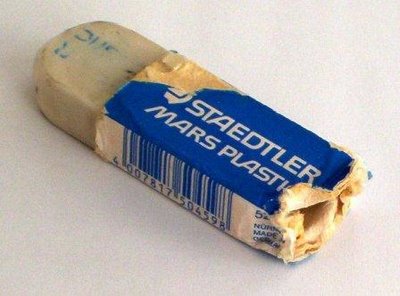 Speaking of the compound, as you erase away, the waste does twist itself up into long strands which are easily removed, just like Staedtler claim. They also claim it is good for removing scuff marks from vinyl floors, marks from light switches and wallpaper, cleaning nail files and a whole lot of other things. I can vouch for the first few – but no idea about the nail file! The compound is relatively odourless – I recall “smelly” erasers being very popular when I was a little fellow at primary school.

 My converters arrived just as pictured, without any instructions. You can also see they are rather different in shape and length to an ordinary Parker ballpoint refill, so exactly how would they fit? They were advertised as allowing you to convert most Parker type pens to pencils. I easily figured out they are a push-top ratchet mechanism and the top pulls off to allow access to the lead chamber.
 So, first up I grabbed a Parker pen and quickly realised it wasn’t going to work. The spring that fits on the front of the pen refill has to be removed for the converter to fit. My particular Parker’s spring appeared to be permanently affixed inside the pen barrel and I just couldn’t remove it. So then I tried another pen, a non-Parker but one that I could get the spring out of the barrel. But again it was all to no avail. It was actually a twist action pen and I just couldn’t get it to operate the converter mechanism.
 So by slowly chopping small amounts off the top stem of the converter I found a length that made it work, and Voila!
 It all woks fine as a standard push top ratchet mechanical pencil, but the lead sleeve is not retractable. So overall, not a bad idea, but a little difficult to get to work in the real world. If you had a pen that you really liked and wanted it to be a pencil, then there’s a chance this converter might just work for you.

 One of my recent acquisitions from a bout of eBay madness is a 1948 catalogue from Autopoint. I’ve got a bit of an interest in general history and I like these old catalogues, magazines and so on as they are a glimpse back into the past. I like to compare them to today and think how things have evolved, and I get to pursue two interests at the same time – history and pencils. I bought my 1948 catalogue from a seller in Australia, and it came with a letter from Autopoint to an Australian company that was enquiring about their products. This is the text of the letter:


 Posts


