Thursday, November 09, 2006

Pentel Ain Lead

A few months ago Pentel Ain won the inaugural Lead Cup so it’s time to do an official review of Pentel leads.
Pentel offer a great variety of graphite leads of many different thickness', hardness grades, quality levels, packaging, etc. For example in ordinary mechanical pencil refill leads they offer 0.3, 0.5, 0.7, 0.9 and 1.3mm thickness leads. In 1.3mm they offer hardness 2B, B, HB and H, but in 0.5mm leads the range of hardness offered expands to 4B through to 6H, including an F grade. They label their apparent quality levels as ‘Hi-Polymer’, ‘Super Hi-Polymer / Ain’, and ‘Premium Hi-Polymer’. Despite the name ‘Premium Hi-Polymer’ it appears that ‘Super Hi-Polymer / Ain’ is their top quality level lead.

As far as I can tell, Ain is just a marketing brandname, the Super Hi-Polymer leads are sold in a variety of containers, quantities per container (e.g. 12, 30 or 40 leads per container) and so on, some as ‘Super Hi-Polymer’ and some as ‘Ain’. All in all there’s an awful lot of apparent choice.

I wasn’t really sure about how to review leads, so I decided to spend a week writing with a selection of different hardness Ain 0.5mm leads. For comparison I also used Pentel Hi-Polymer 0.5mm HB lead. In theory the Ain leads are superior to Hi-Polymer.
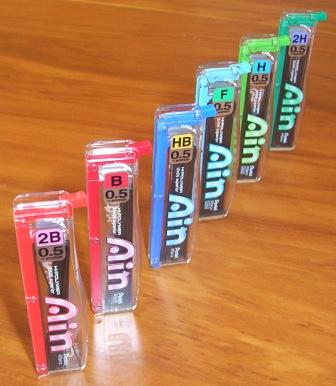
Well let’s get a few of the technicalities out of the way. Reliving the glory days of The Lead Cup, I put a few sticks of lead to the strength test. It was a clear victory, Ain HB is miles stronger than Hi-Polymer HB, so the cynic in me is wrong, there really must be two different formulations. Right then, what about between the hardness grades of Ain? There was a small but clear difference – as you might suspect, 2H was stronger than 2B.

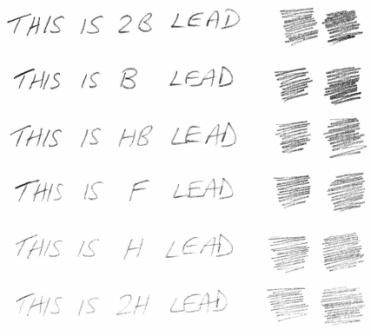
So that’s strength, what about darkness? Just how much difference is there between the hardness grades? Basically I don’t think there is a lot of difference from one grade to the next on the scale, but if you skip a few out then there definitely is a difference in darkness. Anyone could tell 2B from 2H but its pretty difficult spotting the difference between 2B and B. I think they could probably delete every second hardness and not really affect anyone.
I recently had some difficulty with the diameters of some 0.7mm leads, so since my micrometer was handy I ran it across these 0.5mm leads. Grades 2B, B, HB, F, H, and 2H of Ain were all in the 0.565 to 0.57mm range, and the Hi-Polymer HB was 0.56mm. Strictly speaking, if you were correctly rounding to one decimal place, these are all 0.6mm leads, not 0.5mm.
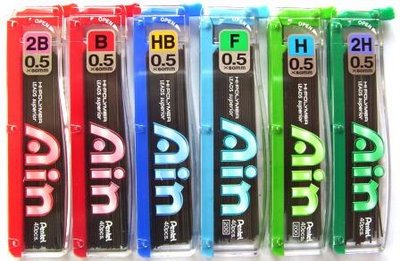
I must admit I’m rather taken by the Ain packaging. I like the clear sided gently curving container and the bright printed graphics. There appears to be a colour coding system in use for the spine and lever top - varying shades of red for the B grades of lead, greens for the H grades, and blues for the HB and F mid-grades. My containers have quite an array of fine print on the back of them relating to plastic recycling. There is some difference in the container markings, indicating it’s a changing thing at Pentel. The F container has no recycling information on it, but all the others do. Now I’m not much of an expert, but as far as I can tell, the marks indicate they are recyclable, and are in fact made from some recycled material – polypropylene and whatever ‘AS’ is. I am guessing its some sort of acrylic-styrene, but I can’t find any reference to what the code ‘AS’ stands for in the plastics recycling schemes. But then again I don’t read Japanese.
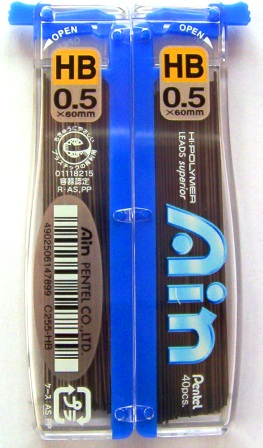
There are 40 pieces of 60mm long lead in each Ain container. You flip the top open by pressing down on the lever with your thumb. Then you give the container a bit of a shake to dispense some lead. Actually this is not really the best. Sometimes you have to give it quite a good shake to get some leads out, and you can get one, or 2 or 3 at a time. Putting surplus leads back in can also be a bit fiddly. I get the impression it’s supposed to be a design that dispenses leads individually, but often lets a few others sneak out.

Now, what about actually writing with the leads! First up I put on my testing hat and did a blind test on the Hi-Polymer HB and Ain HB. Could I tell a difference when just writing under ordinary circumstances? Well, basically no. I had Ain in one pencil and Hi-Polymer in another and swapped them around a few times. I couldn’t tell the difference. Ain was of course stronger, it was undefeated in the strength tests of the Lead Cup, but that doesn’t mean Hi-Polymer was weak and breaking all the time, because it wasn’t. Ain has exceptional strength, but Hi-Polymer is certainly strong enough for normal use.

About 10 years ago I did a year long part-time course in quality assurance. I always remember the time we did a class test on Coke vs Pepsi. This is apparently a standard technique in the food industry. You give the test group three samples each – 2 of one thing and 1 of another and ask them to pick the odd one out. So, my class of 20 or so students were each given three little taster cups of cola – 2 were Coke and 1 was Pepsi. I mean how hard could it be? They taste completely different, don’t they? Well, statistically speaking my class couldn’t tell them apart. Pretty much 1/3rd of the class chose sample A as the odd one out, 1/3rd chose B and 1/3rd C. The lecturer said he had never had a class that could tell them apart, so as much as I can’t believe it, it appears there is no difference between Coke and Pepsi to the taste-buds of the general public. Crazy stuff.

Now note that I said general public. In my class there were two employees from the local Coca-Cola bottling plant. One worked in the laboratory and the other was a genuine ‘taste-tester’. The lady from the laboratory could easily pick the Pepsi by taste, we all watched as she did the three way test a few times and could immediately choose the odd-one out. Then it was the taste-testers turn. He was of course stunned at how useless we all were, a bunch of morons unable to tell Coke from Pepsi. I kid you not, he could tell them apart by sight from a few metres away. Blindfolded he could tell them apart by listening to them – the different levels of carbonation making different bubble sounds! Blindfolded and fingers in ears he could sniff them and tell them apart by smell. So, I’m sure the lead experts at Pentel can tell Hi-Polymer from Ain in the blink of eye, but as for the rest of us….

Well that’s Hi-Polymer out of the way, what about the different grades of Ain? I spent the rest of the week using two identical pencils, one with Ain HB in it and the other with a different grade – 2H, F or 2B.

All the grades are good smooth writing. 2B was slightly smoother than the harder grades, particularly 2H, and if you rotated the pencil to start on a new part of the leads chisel point then you can tell that the harder the grade the more it dug into the paper and took longer to wear down. When I was using the 2H lead I did keep wanting to press harder to darken things up. I put a page of mixed 2H and HB writing through the photocopier and the 2H copies noticeably lighter. Grade 2B definitely wore down faster than HB, so you get more words per stick of lead with HB. I’d guess about a 25% difference. Actually 2B isn’t all that much darker than HB with normal writing, as HB is already quite dark. I did occasionally notice a couple of specks of graphite dust on the page when writing with 2B, and that didn’t happen with the others. Overall I think there is more general difference in 2H to HB than HB to 2B. What about that most unusual of grades, F? It’s really quite hard to tell any difference from HB. I recall a drawing tutor saying that F had the hardness of H and the darkness of HB, but it’s a close call.

Footnote:
Just to clarify the situation, I asked Pentel customer services if there was any difference in the actual leads of Ain and Super Hi-Polymer. They replied, “There is no real difference in the leads, however, the AIN leads are stronger and darker than our original Hi polymer leads.”

Sunday, November 05, 2006

Pencil Danger

Office work can be pretty dangerous stuff. Phalanxes of viciously sharp pencils marching the hallways, ready to impale the unsuspecting newbie intern.

Or perhaps its all just a propaganda campaign by the ink-lords?

Thursday, November 02, 2006

Zebra Jimnie KRM-100 Mechanical Pencil Review

Zebra Jimnie KRM-100 Mechanical Pencil Review

To be honest I’ve never really paid much attention to Zebra’s products. In my part of the world only a small number of their pens and other products, including 2 cheaper models of mechanical pencils, are readily available. I had a few packs of their refill leads because their pencils are usually sold as a set including a pack of refill leads, and so I included them in The Lead Cup. To my surprise they performed quite credibly, so I thought I’d better take another look at their mechanical pencils.


The Zebra Jimnie KRM-100 is a fairly standard looking plastic mechanical pencil. It’s a simple colour scheme, basically a black rubber grip and the rest of the body is dark grey tinted transparent plastic. It’s a lightweight pencil, as you would expect with such construction. The pocket clip is an integral moulding and it’s reasonably functional.

The black rubber grip has a definite ‘rubber’ feel to it, and you know how I’m not very keen on that. The compound is a medium hardness so there is a bit of give under normal finger pressure. Putting on my objective reviewer hat, I will admit that this rubber does improve the grip properties versus normal plastic.

There is a small eraser under the somewhat unusual bullet shaped top cap. The cap reminds me of a robot head from those B-grade 1950’s science fiction films. It sort of has ventilation slits in it, and looks like it’s a two-piece construction with a clear base or body and a tinted U-piece insert. The eraser itself is a rubber compound, and as usual I’m a bit disappointed in it. You can’t put the cap back on without activating the lead advance mechanism.

The lead advance mechanism is a standard push-top ratchet. It has a very good solid positive feel to it when you push the top cap. The 4mm metal slightly conical lead sleeve is fully retractable so its pocket safe. Its also a sliding sleeve so will retract whilst writing as the lead wears down. However I wouldn’t recommend that, as it has a terribly scratchy feel across the paper. Push the top cap and advance the lead straight away!

  • Best Points – The rubber grip is good, and for some reason I really like the robot head top cap.
  • Not So Good Points – Nothing much considering the price range, except for those like me who aren’t really rubber grip people.
  • Price Range – Low, but you usually get a pack of Drafix lead refills as well so its quite a good deal.

Dimensions – Length 146mm, diameter 9mm across rubber grip. Balance point about 80mm up from the tip.

Note: I haven’t seen one, but if you search the web for Zebra Jimnie you basically get the Jimnie Clip which appears to be a similar model but with a document or binder clip. Perhaps the Jimnie has been re-designed and mine is an out-dated variant, even though it’s still on sale down-under?

Sunday, October 29, 2006

Artistic Endeavours

You know, I’ve always had some desire to draw. Being able to draw is actually there on my wishlist. Well this blogging thing has bought me into a little bit of contact with a few artists, and some sketching blogs. It got me thinking, why can’t I draw? Even though I believe I don’t have any artistic talent, surely a lot of drawing is based on a foundation of techniques and skills that can be taught and learned? I haven’t done any engineering drawing for many many years, but I was reasonably OK at that. So I could visualise shapes and objects, see and draw perspective, and so on. Surely mastering some basic ‘technical’ skills and techniques would be within my grasp and mean I could at least learn to draw at a level of ‘technical’ competence, even without artistic talent? So there I was in the shopping mall, and the bookstore had a “Learn to Draw” book on special.

So I drew about 10 circles and cubes from the exercise lessons in the book and then started in on Still Life. These are my first two drawings, a couple of cups from the cupboard, took about 30 minutes each. I know they’re not much, but I’m bizarrely happy with them for my first ever attempts. The other thing is, when it comes to drawing and the equation, ‘Me + Art = ?’ the answer is Staedtler Mars Lumograph wooden pencils. Mechanical pencils don’t really enter my thinking when it comes to art. Strange.

Tuesday, October 24, 2006

Sheaffer Intrigue Mechanical Pencil Review

ATTENTION
This Sheaffer Intrigue has a range of technically advanced features that are unique to this writing instrument. Please ensure you read the use & care guide fully before using it. Failure to do so may reduce the performance of the product.

Well, that’s what it says on the outside of the cardboard box and then you open it up to reveal this!

Crikey! Looks like it’s straight out of the ready-room on the Enterprise – the pencil of Captain James T Kirk or Jean-Luc Picard, but, ummm…, I haven’t graduated from NASA Astronaut school so I’m not sure I’d be capable of using this pencil with all its unique ‘technically advanced features’.

But then again, maybe it would be my entry into another life. You know, Commander Bond and I, living the live of fast cars, beautiful women, and …, international intrigue! Obviously these ‘technically advanced features’ would be fantastic stuff – electromagnetic bullet deflector, ‘knock-out’ gas dispenser, timer detonator - WOW, life was going to be really exciting now I was a man of Intrigue.

So, time to read the ‘Use & Care Guide’. Normally of course, as a real man, I wouldn’t read the instructions until all else had failed, but with such ‘a range of technically advanced features’ this was clearly a special case. So what did this great tome of technical wizardry reveal? Well, pages of stuff in foreign languages I don’t understand, and… oh yeah, it’s an auto-advancer. There’s no knock-out gas dispenser. Ah well, dreams are free, and they say a good imagination is a healthy thing – probably even for a pencil nut.

Sheaffer was acquired by BIC in 1997. The Intrigue was released in 2000 and discontinued around early 2005, but there is still a little bit of new stock available from online retailers. Apparently the Intrigue fountain pen really was an intriguing design, and really was made in the USA.

The Intigue mechanical pencil comes in two finishes, “Whale Shark” which is a rather interesting design of light dots on a blue background, and “Satin Nickel with Palladium” which is my model. It is a two-tone bright nickel/chrome finish. The front sections are slightly darker chrome, like there is a hint of bronze in the chrome, and the upper section is in normal chrome. The only markings on the pencil are ‘Sheaffer’ around the centre and the ‘White Dot’ symbol on the pocket clip.

You know I often find the grip on shiny all metal writing instruments to be a bit of a contradiction, somehow simultaneously smooth and slippery, yet not that bad. The Intrigue fits this pattern. There is no specific grip section or enhancements so the grip can be a little slippery on the smooth metal finish, but overall it’s reasonably good. The Intrigue feels very light for its all metal construction and size.

So, onto the main event, the auto-advance system. Well, actually it is a twist action ratchet lead advance mechanism as well. The twist action is a little difficult to do one-handed as the top 2/3rds of the pencil twists around. The lead sleeve is a conical cone for writing purposes. You operate the twist action the other way to retract the cone for pocket safety. When you want to start writing you operate the twist action to pop the lead sleeve out and then you can manually use the twist action again to advance the lead or you can just start writing. The auto-advance system is quite good and smooth. Probably about as good as they get. There is very little feeling of scraping along the paper as you write, and minimal “scrape through” on existing lettering as you cross over already written lines. I enjoyed writing with it. It seems to work well with either light or heavy hand pressure, although a heavier pressure seems best. When you first start writing you don’t have to manually advance any lead out, but I seem to feel that things worked better if you did. Probably just psychological but its what I felt.

The eraser is a small to mid size one, but very hard to get at. You unscrew the very tight fitting ‘hard to unscrew’ top cap of the pencil. The cap is sealed with a rubber o-ring. No idea why. Waterproofing doesn’t seem to be a requirement for the pencil. You refill the lead chamber via a hole under the eraser. It is a small hole so you can really only feed in one lead at a time and you can’t see how many leads are in the chamber or simply turn the pencil upside down so they fall back out for you to check. Basically its a 'go in and stay in' system. The leads are 0.7mm size. The lead loaded in the pencil by Sheaffer seemed a good quality lead, but these days Sheaffer don’t offer refill leads and neither their literature nor website recommend any particular brand of leads. I contacted Sheaffer customer services to ask what leads they recommended as refills, and they replied any reputable brand, e.g. Pentel or Parker.

Despite the lack of electromagnetic bullet deflector or knock-out gas dispenser this is a pencil worthy of inclusion in any serious collection.
  • Best Points – The auto-advance system.
  • Not So Good Points – Ridiculously difficult to get at eraser.
  • Price Range – High, but clearance specials available.

Dimensions – Length 138mm, diameter 11mm at widest point. Balance point about 70mm up from the tip.

Thursday, October 19, 2006

Royal Coronation Pencils

As a citizen of the Realm of New Zealand, I am of course, a loyal subject of Her Majesty Queen Elizabeth II. Some people think we should redesign our British influenced flag and become a republic, but I think most of us are fairly uninterested in the whole issue. Why bother? She seems like a nice lady, pops over here every once in a while for a cup of tea and a chat, but otherwise leaves us alone. There aren’t any big problems with the current situation, so just leave things as they are, “if it ain’t broke don’t fix it”.

Her Majesty was crowned 53 years ago, back in 1953, June 2, to be precise. Souvenir sellers made a few extra pounds that year, and the mechanical pencil companies wanted a slice of the action.

This ‘Eversharp’ solid sterling silver mechanical pencil is hallmarked for the London Assay Office, 1953, and also carries the additional special 1953/4 commemorative hallmark for the Coronation of Queen Elizabeth II. Unfortunately the hallmark stamps are too small for my rather basic camera to handle, so you’ll just have to take my word for it.

British hallmarks are strictly controlled by the UK government. Up until 1773 the death penalty applied for counterfeiting hallmarks, but it was then changed to 14 years transportation to Australia. Now I’m a Kiwi, but I’m not so biased that I can’t admit that Australia’s a pretty good place too. “Hey, Australia. Nice beaches, cold beer, hot babes, alright – let’s counterfeit some of them hallmark things!” So these days its 10 years in prison, but you don’t get a free trip to Australia as part of the deal.

In the 20th and 21st centuries, the following special commemorative hallmarks have been declared:

1934/5 Silver Jubilee of King George V and Queen Mary
1953/4 Coronation of Queen Elizabeth II
1977 Silver Jubilee of Queen Elizabeth II
1999/2000 Millennium
2002 Golden Jubilee of Queen Elizabeth II

I also have this nice little 11cm long coronation pencil by ‘Makri’, who I haven’t otherwise heard of. It has “Coronation, E II R, 1953” printed in a shield on the body. It is in excellent condition. The crown on top is complete with little glass jewels in it. The blue and red stripes are a bit wavy though, not really sure if that is by design or they just couldn’t do any better at the time. You twist the metal tip section to propel the lead.

Here’s a similar pencil, of unknown brand. The top piece on this one is a circular shield standing up with “Coronation, June 2, 1953” on one side and a jewelled crown on the other. If the British press is to be believed then sometime in the future this young lady will be Queen. She will therefore be our first Queen to have walked the catwalk modelling her underwear. But some of those royals from older times were a pretty raunchy lot, so a bit of a lingerie parade is rather tame stuff in comparison. I will be surprised if they have mechanical pencils celebrating her future-husband being crowned King. I’m sure there will be a few coins and other things, but unfortunately I think the day of the souvenir mechanical pencil has been and gone. :(

Of course Her Majesty does have another link to the world of pencildom. The well known pencil company Koh-I-Noor took its name and colour scheme from the famous koh-i-noor diamond, which was once the largest diamond in the world. Her Majesty can wear the koh-i-noor, because it is part of the Crown Jewels, set in the coronation crown of the late Queen Elizabeth The Queen Mother.

Footnote: The wooden pencil companies wanted some of the action too - see Pigpog for a Coronation Souvenir wooden pencil.