Cult Pens are having a Mechanical Pencil Day... well it will last longer than a day, but you get the idea. July 05. Specials, promos, blog posts and other stuff. So, head on over there to check it out.
Also, check back here on July 5 for a giveaway provided by Cult Pens.
Sunday, July 01, 2018

Saturday, June 30, 2018
Sailor Professional Gear Mechanical Pencil Review
Sailor Professional Gear Mechanical Pencil Review
Continuing on with a bit of a recent theme, here’s another mechanical pencil with a nautical connection. Sailor Pens, founded in 1911, is a well-respected but I would say not particularly well known Japanese manufacturer.The Sailor Professional Gear writing instruments come in a range of colourways and formats – fountain pen, ballpoint and mechanical pencil. There are also two versions of the series, the Professional Gear and the ProGear II. From the Sailor catalogue, the difference between the two versions seems to be that the ProGear II is 3mm longer and has the Sailor anchor style pocket clip. My pencil is the Sailor Professional Gear mechanical pencil, model 21-1036-720.

Right up front, I should stress that I am only an amateur sailor so my credentials to review Sailor Professional Gear are questionable.

The Sailor presentation box is modest and nice enough, but not nice enough to warrant a picture. Open the box up though and we have a nice mechanical pencil. The overall style and shape of the Professional Gear is relatively similar to a number of other manufacturers. The body is a nice shiny black PMMA resin (acrylic) and the 24K gold plated trims look good.

The larger diameter top half of the body gives the pencil a top heavy sort of look, your choice if you like that style or not. The gold centre rings also contribute to the wide top heavy look. The wording “SAILOR JAPAN FOUNDED 1911” is engraved into the centre ring.
Moving up the body, the pocket clip is equally substantial with some spring but quiet firm.
On the top of the end cap there is the gold anchor emblem of Sailor. All nice good looking trims.


Down at the business end of the mechanical pencil the lead sleeve is a simple cone suited for general writing. My pencil is 0.7mm lead. The lead advance mechanism is a push top ratchet and 10 clicks advances 6mm of lead.
Here are the refill instructions that came with the mechanical pencil.

So, the question dear reader is how to get to the pictured eraser and lead refill chamber? Does one simply pull the whole top half of the body off, or does one unscrew the top half of the body? I have seen both options on other mechanical pencils, and using the wrong option is generally not good. A little bit of gentle twisting and pulling did not really indicate which is the correct option so it was off to the web. Buried in the Japanese language website, not the English language site, is a clearer set of instructions which show that you unscrew the top half of the body. The Japanese site is also more specific about the excess lead overfilling warning, stating 2 sticks of lead.

The eraser is bigger than some but having to unscrew the body means access is a bit laborious.
In the hand the Sailor Professional Gear pencil is as mostly as expected. It is top heavy but at about 22g it feels lighter than its looks might indicate. The 12mm diameter lower body is still quite wide so this is definitely not a pencil for those who like a slim grip zone. The grip zone is of course plain acrylic without and grip improvement features so again that will not suit those who like a very positive grip.
Overall then the Sailor Professional Gear mechanical pencil is a nice but not spectacular high end general writing pencil.
• Best Points – Aesthetics
• Not So Good Points – Does not really feel as substantial in the hand as it looks.
• Price Range – High
• Does this pencil make it into the Top 5? – No
Dimensions – Length 139mm, diameter 12mm across the lower body section. Balance point about 80mm up from the tip.
 |
| Through the mists of time |

Monday, June 18, 2018
Barunson 2.0 Multi Sharp Mechanical Pencil Review
Barunson 2.0 Multi – 2B Sharp Mechanical Pencil Review
This pencil was sent to me 9 years ago by my friend Kent from Korea. I suppose anyone who has a collection of something has a few guilty items in their collection. You know, a couple of items that they really shouldn’t like, but they do. Well, this Barunson mechanical pencil is one of mine. I really like it, but it’s not a particularly good pencil.Online searches show this Barunson pencil is usually sold as a combo pack deal of two or three different colourways of the pencil along with a mixed pack of coloured leads. This seems to imply Barunson are aiming at the arts and crafts market. Searching online also seems to only bring up this one pencil so perhaps it is the only one they market under their brand. My Korean friend tells me that Barunson were a reasonably significant stationery company in the school and childrens market segment but in 2014 they sold their stationery business to a small company called Barunson Plus. Barunson Plus have themselves been in financial difficulty for quite a long time and have been applied to the courts for various protections. Apparently because of the rapidly declining younger demographics within the Korean population many commercial sectors such as dairy products, paediatric medicines and stationery are facing very difficult market conditions in Korea. Wikipedia even states
“In fact, the speed of aging in Korea is unprecedented in human history…”
Firstly then, I quite like the way it looks. A long slim lightweight white plastic body with silver and chrome trims. I don’t have many white pencils so perhaps that’s part of its attraction for me. The pocket clip is very sturdy and, like the body, seems of very good quality.

The body is round but the grip section is triangular. It’s ridiculous. The flat sections of the grip which your fingers make the main contact with are smooth and the rounded corners of the triangle which you don’t touch have grooves on them. Surely it should be the other way around?

The lead advance is a standard push top ratchet. Ten clicks will advance 11mm of lead. Having said that, the mechanism isn’t totally reliable, and very occasionally a click will not advance any lead.
When writing you should not hold the pencil too vertical and/or push too hard as the clutch system is not very strong and the lead will slide back up into the tip if too much pressure is applied. A few economy grade pencils have similar problems, e.g. the BIC Matic Classic.
The tip of the pencil is a short fixed sleeve but being plastic to suit 2mm lead this means it is fairly blunt so is basically pocket safe.
Being a 2mm lead mechanical pencil it does not hold any spare leads inside the pencil body. You pull the push top button off to insert a new lead. Not too surprisingly there is no eraser under the top button. On the other hand there is a lead sharpener inside the push top button. It is fairly vicious and one of those styles that can leave a long thin shaft projecting out from the conical tip.


Like many 2mm pencils the Barunson has a lead hardness indicator, a simple twist ring to show the grade, with grades HB through to 4B available.
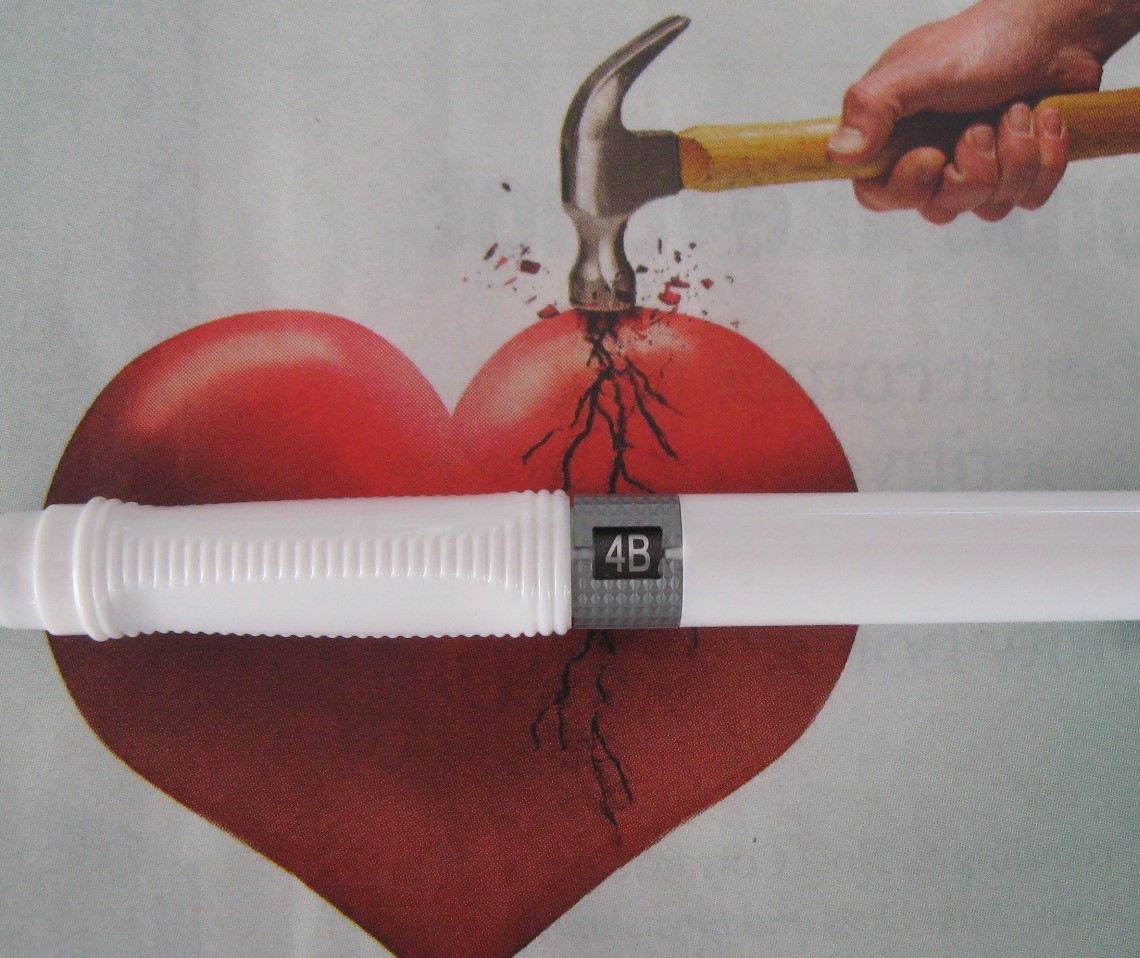
The adhesive label on the body includes the word “China” so that must be the country of manufacture.
This mechanical pencil is a mixed bag. The actual body moulding and pocket clip seem of very good quality, the design seems aesthetically pleasing but functionally questionable (grip section, sharpener) and the mechanism is definitely questionable. Still, somehow, I like it, and am glad to have it in my collection.
• Best Points – Looks. Good external body build.
• Not So Good Points – Grip section, weak lead clutch.
• Price Range – Low (when you divide the pack price up)
• Does this pencil make it into the Top 5? – No way.
Dimensions – Length 150 mm, diameter 9mm across main body. Balance point about 80mm up from the tip.
Friday, June 08, 2018
More Ravages of Time
I have two acrylic body pencils made by a pen turner. The first (top, 2-piece) one he made for general sale and the second (bottom, Duofold style) was commissioned by myself.
I must admit I was very surprised to see what has happened to these mechanical pencils over time. Firstly the gold fittings are in excellent condition, as good as the day I first saw them. I really never expected much from the gold trims and would not really have been surprised to see some corrosion showing through. But, as I said, nothing. They are as good as the day they were made. So what has gone wrong and surprised me? Well the acrylic bodies have deteriorated. Unfortunately you can’t see it in the images, but you can see and feel it in real life. The acrylic has developed small ridges / waves / indents / dimples… whatever you like to call them. The Duofold style pencil is definitely worse than the other, but both have the same deterioration. The Duofold style pencil acrylic body also has an actual delamination in one part down where it joins the tip.
The two piece body pencil also has another problem. The two halves have started to separate so that there is now a 1mm gap between the bodies and the centre joining ring.
These two pencils are about 9 years old and I thought I would contact the maker to get his comments. I wasn’t really complaining, just giving him feedback, and he replied quite promptly. He is no longer in the pen game, the quake of 2011 put an end to his business, and he is now retired. Nevertheless he was interested to hear from me and had a few comments in reply, slightly paraphrased below.
In the old days I know that a couple of pen turners used to be regular readers of this blog, so I would be very interested to hear any comments from turners, or from readers who have had similar problems.
Don’t worry, this is last planned post about the Ravages of Time.
 |
| I really liked both these mechanical pencils when I bought them. Now... not so much. |
 |
| Ouch! Nasty sharp little protruding delamination. |
 |
| Gap between body and centre ring joiner |
The issue with the ridging etc sometimes occurs right from the outset. It seems to be caused by the ribbons that are inserted in the acrylic pour to make the swirls. The technique involves two separate consistencies of mix, one always harder than the other. The gaps in the two-piece pencil centre are the brass inner tubing slipping on the joining knuckle (possibly from heat fluctuations). The pencils have a solid brass tube skeleton and are pressed together. Consequently they are held in place by friction only. I can't say what may have caused the delamination of the acrylic near the tip. Atmospheric humidity maybe?It’s disappointing to hear the acrylic wave problem basically being a known-problem. I doubt the modern high end luxury manufacturers who use marbled acrylics have the same problem. I can confirm that my marbled Parker Duofold Centennial doesn’t have this problem, nor do my vintage Conway Stewarts.
In the old days I know that a couple of pen turners used to be regular readers of this blog, so I would be very interested to hear any comments from turners, or from readers who have had similar problems.
Don’t worry, this is last planned post about the Ravages of Time.
Friday, June 01, 2018
Old Friends
A couple of old friends from the desk, still going strong, but probably not for much longer :)

Jeopardy is updated, now down to 655. And from the comment archive, this gem put a smile on my face.

Jeopardy is updated, now down to 655. And from the comment archive, this gem put a smile on my face.
Maybe we collectors are the villains here - why does any of us need so many pencils? (My wife told me to say that. I'd like to know why any one with only two feet needs that many shoes.)
Tuesday, May 22, 2018
Spoke Design Interview
Spoke Design Mechanical Pencils
I first became aware of Spoke Design back in July 2012 when they launched a Kickstarter campaign for a mechanical pencil. The campaign was a success with 318 backers funding US $16,782. That was the original Spoke mechanical pencil, Spoke 1, and now they are onto the Spoke 4 mechanical pencil. I have recently been in touch with Brian from Spoke and thought it would be interesting to do an interview with him. Happily, Brian agreed.****
1 - So, Brian, tell us a little about yourself and Spoke Design.
I’m a mechanical design engineer and I live in Charlotte, North Carolina USA. I have spent my whole career in new product development. The majority of my career has been working for corporations in various industries (telcom, barcode equipment, security devices). The bulk of my experience is actually in plastic part and product design, but I am a hobby woodworker and a very hobby machinist. I have been working full-time on my own for over a year now. The Spoke brand is a part of the product design and development company I run with my brother Dan… aptly named Conti-Bros, Inc. It’s a small enterprise… it’s just us two and Dan is part-time.
2 - I imagine as a mechanical design engineer you have used a pencil or two throughout your career?
Absolutely… I sketch out ideas constantly, so pencils are my preference for that. I’ve always been a user and fan of the Pentel Sharp pencils… probably because they have been somewhat of a standard throughout the years. I’d say I use .5mm most often… and I prefer 2B lead.
3 - Let’s quickly go through some history. Spoke 1…. Was it a case of one day you were just sitting there and thought “I want to design and make a good mechanical pencil and sell it to some people.” So you did? Perhaps though there was a little bit more to it than that, a long evolutionary process?
Years ago I was browsing online and I ran across a news article about how this new website called Kickstarter had just had their first million dollar project (a machined iphone stand I think). I had never heard of Kickstarter or crowdfunding… when I looked up the site I became fascinated with how it could be used to find, test, or create a market for new unique products. I had to give it a try. My first two submissions were actually rejected by Kickstarter… they were designs for ‘active foot rests’. As I spent so much time at my desk, I had made prototypes of these for myself to allow some ‘fidgeting’ with my feet. Back then, Kickstarter didn’t allow ‘exercise products’ so they rejected my submissions (they have since changed their policy and others have successfully funded several similar products to what I had originally submitted). Undeterred, I noticed a few machined pens really becoming popular on Kickstarter… so I decided I could try to see if there was a similar interest for a machined body mechanical pencil… my preferred sketching instrument.
Many of the pens on Kickstarter are simply ‘minimal’ cylinders… largely indistinguishable from each other. My goal was to make something very distinct and immediately recognizable by its design… after lots of sketching and prototyping… I settled on long slot features to be the signature design element. The Spoke name seemed a natural description of these features. The project was a moderate success on Kickstarter (after all pens are a much bigger market versus mechanical pencils), and that’s how Spoke got started.
4 - Spoke 1 was obviously a success by whatever measures you personally use because you have carried on and now there is Spoke 4. What’s the one big thing you learned from the Spoke 1 campaign? By the way, what do you call the original Spoke mechanical pencil now there’s more than one?
Spoke 1, Spoke Original – I’ve called it both. From the outset, I had planned to do versions of the pencil… the initial pencil is designated by a machined ‘dot’ on its end… so I also refer to it as Spoke Pencil single dot.
There were three big takeaways from Spoke 1 (single dot)…
First, while I can make various types of prototypes, for production quantities, I had to develop a capable supply chain for my intricately machined and anodized parts. It’s fun creating relationships with machine shops and working together to produce cool parts. It’s always exciting and fulfilling to take something from sketch to physical product, but volume manufacturing has its own set of challenges and learnings as well.
Secondly, the initial project provided an introduction to the Kickstarter system. Crowdfunding is a unique process with lots of things to learn. Since the original Spoke Pencil we’ve used Kickstarter to fund several other products (most notably a brand of magnetic products under the brand of Strong Like Bull Magnets.
The third thing I’ve learned is that selling products online is quite difficult. As a design engineer, I had little experience with e-commerce, marketing, website creation, etc. I’ve since learned quite a bit through the years… and continue to work on this area.
5 - With perfect hindsight, what would you have done differently?
While I’ve learned a lot along the way and have definitely had some missteps… those things were part of the journey so to speak. Overall I’m happy with the path I took.
6 - The wood turning folk have always had pen and pencil mechanisms readily available for their use. One of the intriguing features of Spoke 1 was your use of Pentel P205 mechanisms. I’m imagining you buying a few hundred Pentel’s from a local store, ripping their mechanisms out (sacrilege!) and assembling them into your Spoke bodies. Is that what actually happened? Where are you sourcing your pencil mechanisms from now?
I buy the standard pencils wholesale from a distributor. The great thing about the Pentel P200 series is that they are readily disassemble-able. This makes it easy for me to utilize the mechanism and also easy for customers to get ‘replacement parts’ if ever needed.
7 - Tell us about Spoke 1, 2, 3 and 4. What’s different about them? What did you learn from each and think you would like to try on the next variant? Has feedback from users influenced you much?
 |
The Spoke Design series of mechanical pencils. Top to bottom, 4 to 1.
Photo courtesy of Brian
|
Spoke Pencil (single dot)… the original. A one piece pencil body utilizing the P200 series mechanism. The body is machined from aluminium, has a swooping profile with hexagonal cross section and of course the six signature slots. There’s quite a bit of machining going on there. It was funded on Kickstarter and now retired from sale, although I do have a few reworked pencils I sell occasionally.
Spoke Pencil 2 (double dot). Spoke 2 was a follow up design that was more a refinement than new design. The main change was a slightly smaller profile and a bit narrower slots. It was released on my website and not a Kickstarter project. Spoke 2 is now retired from sale, although again, I do have a few reworked pencils I put for sale occasionally.
Then there was Spoke Inverse. The inverse was a shift to a more simple cylindrical design, with the main feature being an inverted taper in the grip area. Inverse was a smaller pencil altogether, using the Pentel P225 mechanism (since discontinued). It was released on my website only. Inverse is retired from sale, although I do have a few reworked pencils I sell occasionally.
Spoke Model 3 (triple dot). The model 3 was a big departure in design and material. I decided to go with Titanium. Design-wise it has a stepped profile with circular cross sections, bevelled edge slots, and a heavily grooved grip. The model 3 proved to be quite difficult to machine… and ultimately only 100 were made. Model 3 was released on my website… and is now sold out.
Spoke 4. By this point I had received a good amount of feedback and requests from customers for various materials, colors, and grip sizes. There’s no one perfect pencil configuration to satisfy everyone, but I thought it would be unique to offer a degree of customization to try and address common requests. The solution was a two piece body design in order to provide a range of material, color, and size options to customers. This level of customization has proven to be popular. The model 4 is an interesting pencil in that depending on configuration it can vary significantly in how it looks and feels… many customers order 2 or 3 and mix up their order configurations a good bit. I’ve decided to make the model 4 a ‘standard’ pencil with no plans to retire it any time soon. In fact, I plan to add some additional colors.
8 - As you have mentioned, the Spoke 4 mechanical pencil is a pick ‘n’ mix of 5 different grips, each in 2 diameters, and 5 different barrels, so that’s 50 combinations. Which combination if your personal favourite? Is there any clear preference from customers for grip diameter, grip material or barrel colour?
I have several pencils on my desk, so I do mix up what I use quite a bit. Overall I probably favour the smaller diameter 8.3mm grip in Titanium with a blue barrel. The titanium moves the balance point closer to the tip while not adding too much overall weight, and the blue provides a nice contrast to the spoke grooves. As for customers, the classic look of Titanium with a black anodized barrel is most popular. Orders are generally split pretty evenly between the 8.3mm and 9.2mm grip diameters. While the dimensional difference seems quite small… the result is a big difference in feel.
9 - You have offered your various Spoke pencils in 0.5, 0.7 and 0.9mm lead sizes. What has been the most popular?
The .5mm is the most popular… I’d say half of all orders are for .5mm with the remainder spilt pretty evenly between .7mm and .9mm.
10 - You have also branched out into some other stationery related items. I guess anything on your desk is fair game?
I have quite a diverse background in the types of products I have developed. Under Spoke, I’ve done a machined ring holder and more recently a machined note holder… both on Kickstarter. While I do enjoy the challenge of working on a variety of product categories, I really enjoy working on writing instruments… and expect to keep releasing new Spoke designs going forward.
11 - Okay, well thanks for telling us this Brian. All the best for the future… so Spoke 5 is already in your thoughts?
Yes, Spoke 5 is coming! I’m at the prototype stage and hopefully it’ll be ready to go in the next month or so! However, the model 5 is more exploration of the spoke design… not a model 4 replacement.
****
I will leave you another nice photo supplied by Brian.
 |
| L to R - The history of Spoke pencils to date |
Subscribe to:
Posts (Atom)


 Posts
Posts


